Visual explainer
Ensemble Methods
Combining multiple diverse models to produce a single, more accurate and robust prediction.
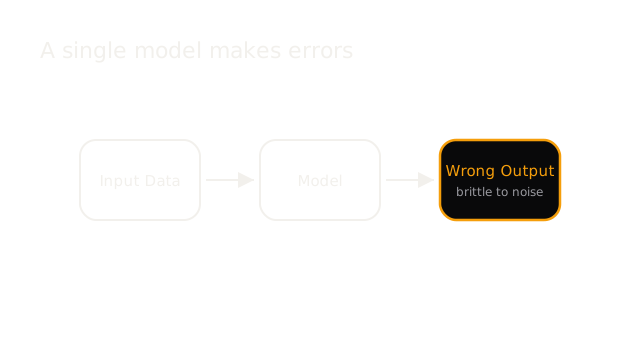
A single model makes its own mistakes. An isolated decision tree or linear regression might overfit to noise or underfit the true pattern.
Diverse Models
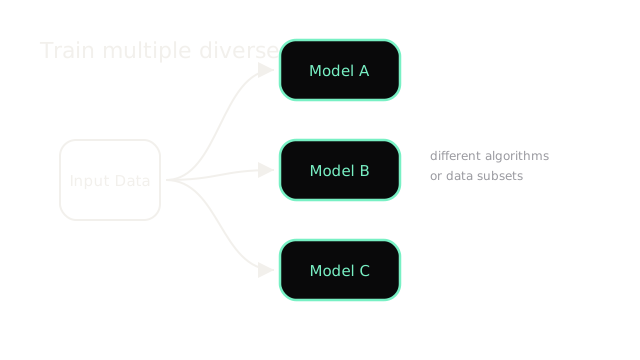
Instead of relying on one model, we train a group (an ensemble) of different models. Diversity is key: they should be trained on different data samples or use different algorithms.
Majority Vote
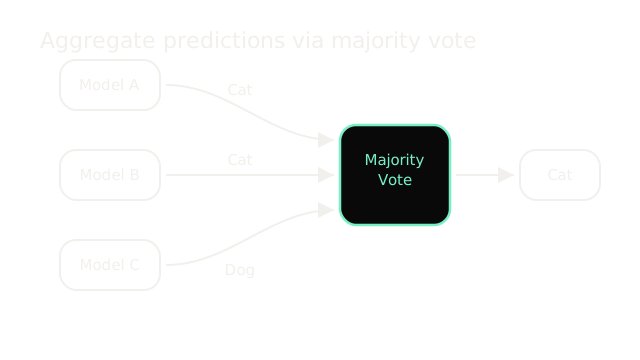
When predicting, every model in the ensemble gets a vote. For classification, we take the majority; for regression, we take the average.
Robust Consensus
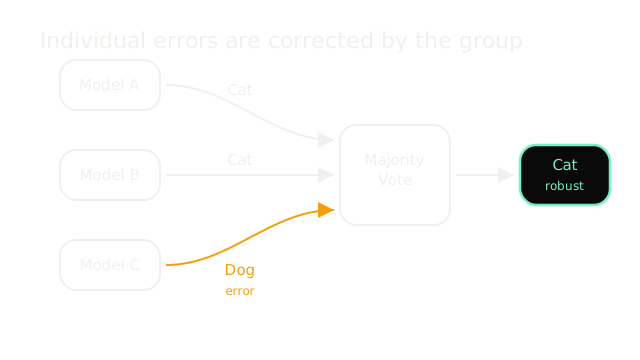
If the models are diverse, they won't all make the same mistake. The correct predictions outvote the occasional errors, yielding a robust final output.
Where It Breaks
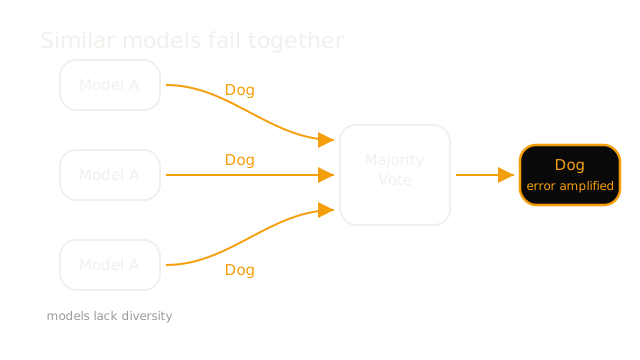
If your models are too similar, they will all fail together. An ensemble of identical models provides no benefit — diversity is the mathematical requirement.
The Quick Version
- One model: Vulnerable to noise and singular errors.
- Ensemble: A collection of diverse models.
- Aggregation: Combine outputs via voting or averaging.
- Robustness: Individual errors cancel out.
- Requirement: The models must be mathematically diverse.
What to Read Next
- Random ForestsTrain hundreds of trees on random slices of data, let them vote, and watch individual errors cancel each other out — leaving a model that generalises far better than any single tree.
- Gradient BoostingChain weak learners so each one corrects only the mistakes of the one before it — an additive process that converts many shallow models into a powerful ensemble.