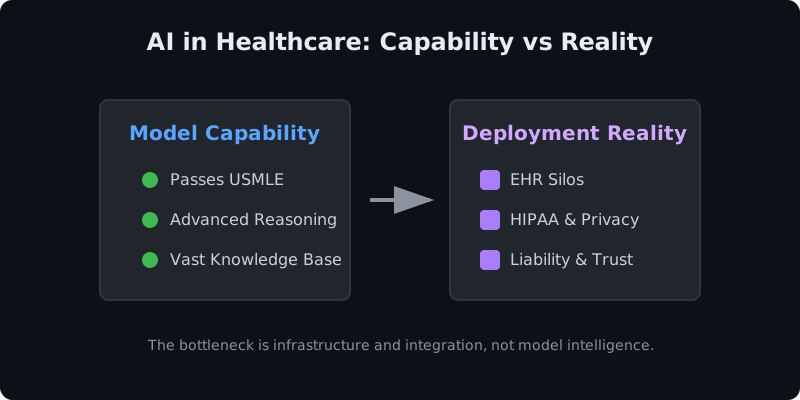
AI in Healthcare is a Deployment Problem, Not a Model Problem
The Illusion of Solved Healthcare
Every month, a new state-of-the-art model is released with the headline that it scored in the 90th percentile on the USMLE. The narrative suggests that AI doctors are ready to augment or even replace human triage. But walk into any major hospital, and you'll find that AI deployment is moving at a glacial pace.
The gap isn't in model capability. It’s in infrastructure, liability, and the messy reality of clinical data. We are solving for medical trivia when the real challenge is safe, robust deployment.
The Reality of Clinical Workflows
Building LLMs that understand medical text is only step one. The actual use cases driving value today aren't diagnostic replacements—they are operational and administrative.
- Ambient Clinical Documentation: Listening to a doctor-patient conversation and drafting the EHR note automatically.
- Medical Coding: Extracting the correct billing codes from clinical notes.
- Patient Triage Support: Summarizing a patient's dense history for the physician before they walk into the room.
These sound simple, but they require integrating with legacy Electronic Health Record (EHR) systems that aggressively resist modern APIs. Furthermore, clinical Data Quality is notoriously poor. Medical records are full of abbreviations, copy-pasted blocks, and missing context.
Why Deployment Stalls
The technical hurdles are largely MLOps problems disguised as healthcare problems.
- Data Silos & Privacy: You cannot just pipe patient data into a public API. Hospitals require on-premise or HIPAA-compliant VPC deployments. This means dealing with local Model Serving and maintaining secure infrastructure, which many health systems lack the talent to build.
- The Liability of Hallucination: If a model generates a false citation in a marketing blog, it's embarrassing. If a model hallucinates a medication dosage or misses a critical allergy in a patient summary, it’s a malpractice lawsuit. The tolerance for error is practically zero.
- Evaluation is Hard: You can't benchmark a clinical assistant with static datasets. You need domain experts (doctors) to review Retrieval-Augmented Generation (RAG) outputs, which is incredibly expensive and slow.
Stop Chasing Benchmarks
If you are building AI for healthcare as of late 2026, stop fine-tuning models to score higher on multiple-choice medical exams. Start solving the plumbing. Build better RAG systems that can cite the exact paragraph in a messy PDF where an allergy is mentioned. Build robust evaluation pipelines. The winners in this space won't be the teams with the smartest models; they will be the teams with the safest, most integratable deployments.
(Correct as of September 2026).