Stop Fine-Tuning to Teach Your Model Facts
The Default Mistake
Every engineering team starting with generative AI eventually hits the same wall: the base model doesn't know their company's internal data, or it refuses to format responses exactly the way their legacy API expects. Inevitably, someone says, "Let's just fine-tune it."
In 2026, reaching for fine-tuning as your first lever is usually a costly mistake. The ecosystem has bifurcated into two distinct tracks: injecting knowledge, and shaping behavior. Mixing them up leads to brittle, expensive systems.
When to Use Prompt Engineering (and RAG)
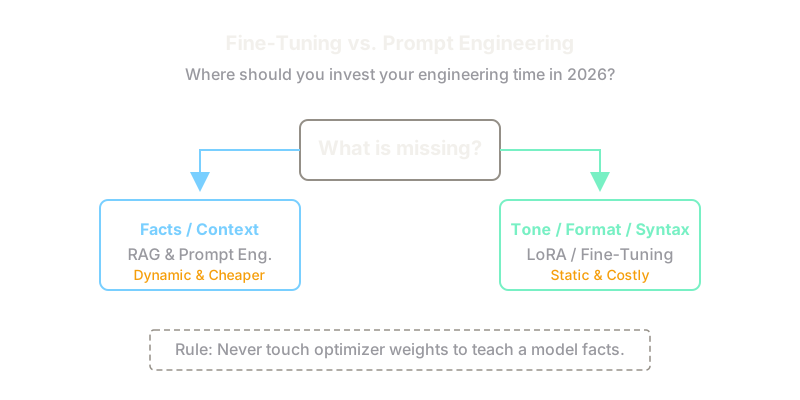
If the gap in your model's performance is about facts, context, or current events, you need prompt engineering and Retrieval-Augmented Generation (RAG).
Models are terrible databases. Trying to bake your 2026 Q3 earnings report into a model's weights via fine-tuning is like trying to memorize a phone book instead of just looking up the number in a vector database.
- Dynamic: You can update a database instantly. Updating weights takes hours of GPU time.
- Traceable: When a model hallucinates, RAG lets you check the exact context chunks it was given. Weights are a black box.
- Cheaper: Pushing context into the context window costs fractions of a cent. Spinning up an H100 cluster for a training run does not.
When Fine-Tuning Actually Makes Sense
Fine-tuning (specifically parameter-efficient methods like LoRA) shines when you need to change the model's form, not its substance.
If you need the model to consistently output valid JSON matching a highly specific proprietary schema, or you need it to adopt the precise cynical, witty tone of your brand's mascot, prompt engineering will eventually hit a ceiling. Even with a brilliant system prompt, the model will occasionally slip back into its default "helpful AI assistant" persona.
Fine-tuning alters the model's fundamental probability distribution over vocabulary. It teaches the model how to speak, not what to say.
The Quick Version
If you need the model to know something new, put it in the prompt. If you need the model to fundamentally act differently or reliably adopt a complex syntax, fine-tune it. Never touch an optimizer weight to teach a model a fact.
(Correct as of September 2026).