Why RAG is the Only Way Forward for Enterprise AI (A Beginner's Guide)
The AI hype cycle has convinced many organizations that they can simply plug a Large Language Model (LLM) into their data and instantly automate their business. This is a dangerous misconception. Out-of-the-box LLMs are incredibly articulate, but they are also confident liars when they lack context. If you want enterprise AI that actually works, there is only one viable architecture right now: Retrieval-Augmented Generation (RAG).
The Problem: Confident Hallucinations
An LLM is fundamentally a next-token predictor trained on a snapshot of the public internet. It doesn't know about your proprietary HR policies, your internal API documentation, or the customer support ticket filed five minutes ago. When asked a question about these private topics, an unassisted LLM will often guess—a phenomenon known as hallucination.
In a consumer setting, a hallucination is mildly annoying. In an enterprise setting, it's a liability. You cannot deploy a system that invents company policies or fabricates financial figures.
The Fix: Grounding AI in Reality
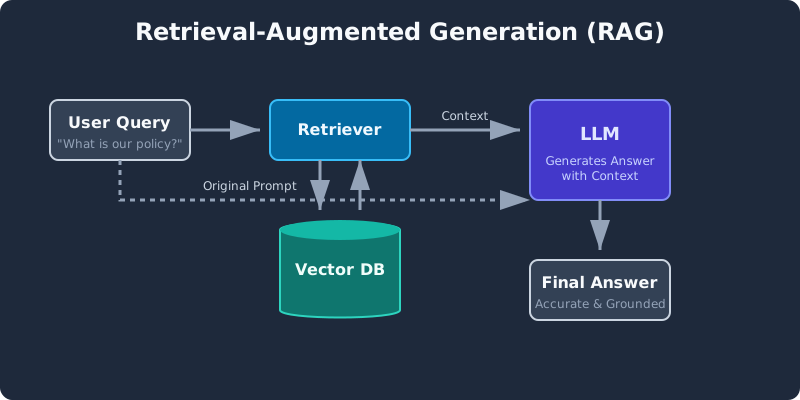
This is where RAG comes in. Instead of relying on the LLM's static internal memory, RAG intercepts the user's prompt and fetches relevant facts from a trusted external database before generating an answer.
The mechanism is surprisingly straightforward:
- Retrieve: When a user asks a question, the system searches your private knowledge base (often using a vector database and embeddings to find semantically similar documents).
- Augment: The retrieved documents are appended to the user's original prompt as context.
- Generate: The LLM reads the newly enriched prompt and synthesizes a response based only on the provided facts.
By forcing the model to read the answer from a trusted source before speaking, RAG effectively turns a creative storyteller into a rigorous research assistant.
Why Fine-Tuning Isn't Enough
A common misconception is that you can just fine-tune a model on your company's data. While fine-tuning is great for teaching a model a new tone of voice or a specific output format, it is a terrible way to teach it facts. Updating a fine-tuned model requires a complete retraining run, which is slow and expensive.
With RAG, updating your AI's knowledge is as simple as adding or deleting a document in your database. It's modular, auditable, and instantly up-to-date.
The Verdict
If you're building an internal tool, a customer-facing chatbot, or any application where accuracy matters, RAG isn't just an option—it's a requirement. As of September 2026, relying purely on a model's parameterized memory for business-critical tasks is architectural malpractice. Ground your models in reality, or don't deploy them at all.
(Correct as of September 2026).