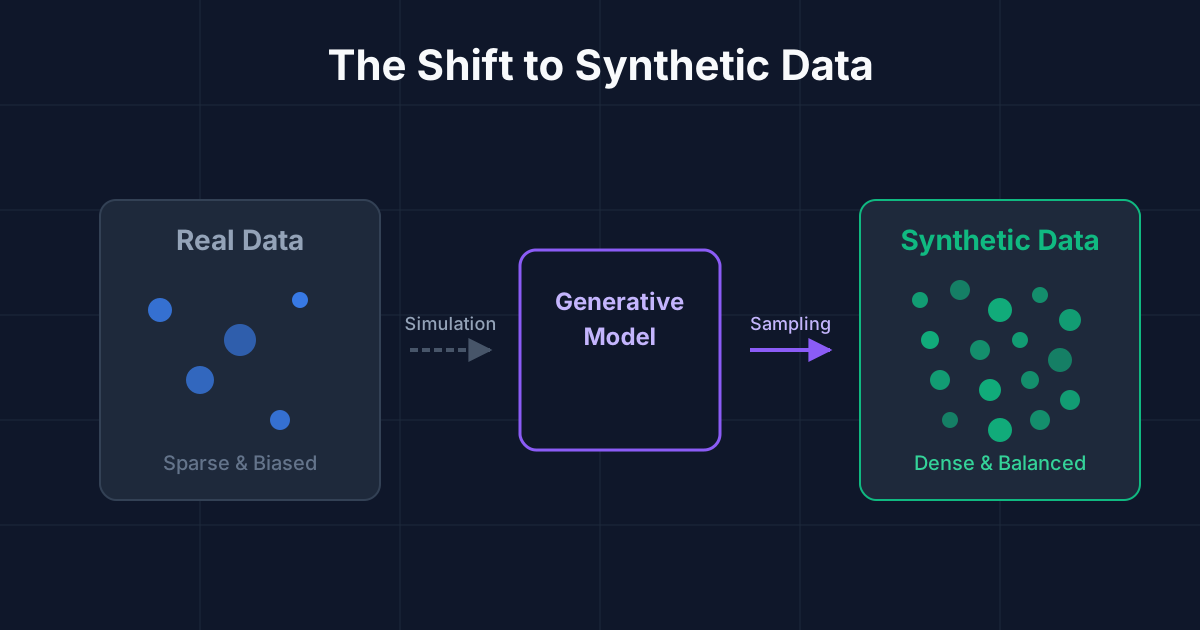
Synthetic Data is No Longer a Fallback
The Paradigm Shift
For years, the standard advice in machine learning was simple: get more human data. We relied on data augmentation only when absolutely necessary, stretching small datasets by cropping images or paraphrasing text. But in late 2025 and throughout 2026, the landscape shifted fundamentally. Today, the most capable models aren't just supplemented by synthetic data—they are primarily trained on it.
When OpenAI released the o1 family of models and Anthropic scaled Claude 3.5, the secret sauce wasn't a newly scraped corpus of the web. The open web has largely been exhausted. Instead, the breakthroughs came from highly curated synthetic data generation pipelines where strong models teach smaller or next-generation models how to think.
The Real Data Wall
The internet is vast, but high-quality, step-by-step reasoning is surprisingly rare. Human writers skip steps. We assume context. We make logical leaps. When training a model to perform rigorous chain-of-thought reasoning, human data is often too noisy and unstructured.
This is where synthetic data excels. We can prompt a frontier model like GPT-4 or Llama-3.1-405B to generate thousands of complex math problems, complete with exhaustive, perfectly formatted step-by-step solutions. If a solution is wrong, automated verifiers can filter it out. The result is a dataset that is denser, cleaner, and more instructive than anything you could scrape from a forum.
The Control Factor
Beyond just scaling up, synthetic data gives researchers unprecedented control over the distribution of their training set.
If you are training a code generation model and realize it is failing on edge cases in Rust, you don't need to hope that someone on the internet writes more Rust edge cases. You simply prompt your synthetic pipeline to generate 10,000 highly difficult Rust concurrency problems. This targeted generation entirely bypasses traditional data cleaning bottlenecks. You aren't panning for gold in a river of noise; you are synthesizing gold in a lab.
Where People Get it Wrong
The most common misconception is that "models training on model data leads to model collapse." This is only true for naive, unfiltered self-consumption. Modern synthetic data pipelines involve rigorous verification steps. A generator proposes a solution, and a verifier (which can be a compiler, a math engine, or an even larger reward model) checks it. The model only learns from the verified successes. This rejection sampling fundamentally breaks the loop of compounding errors.
The Quick Version
The era of web-scale scraping as a competitive advantage is plateauing. The new frontier is synthetic data. By using models to generate, verify, and filter training data, developers can create perfectly balanced, high-signal datasets that push the boundaries of reasoning and domain expertise.
(Correct as of September 2026).