The Transformer Architecture Won Because It Replaced Elegance with Brutal Parallelism
If you listen to modern AI marketing, you might think the Transformer was the discovery of a synthetic brain. It wasn't. It was an engineering compromise that happened to scale incredibly well.
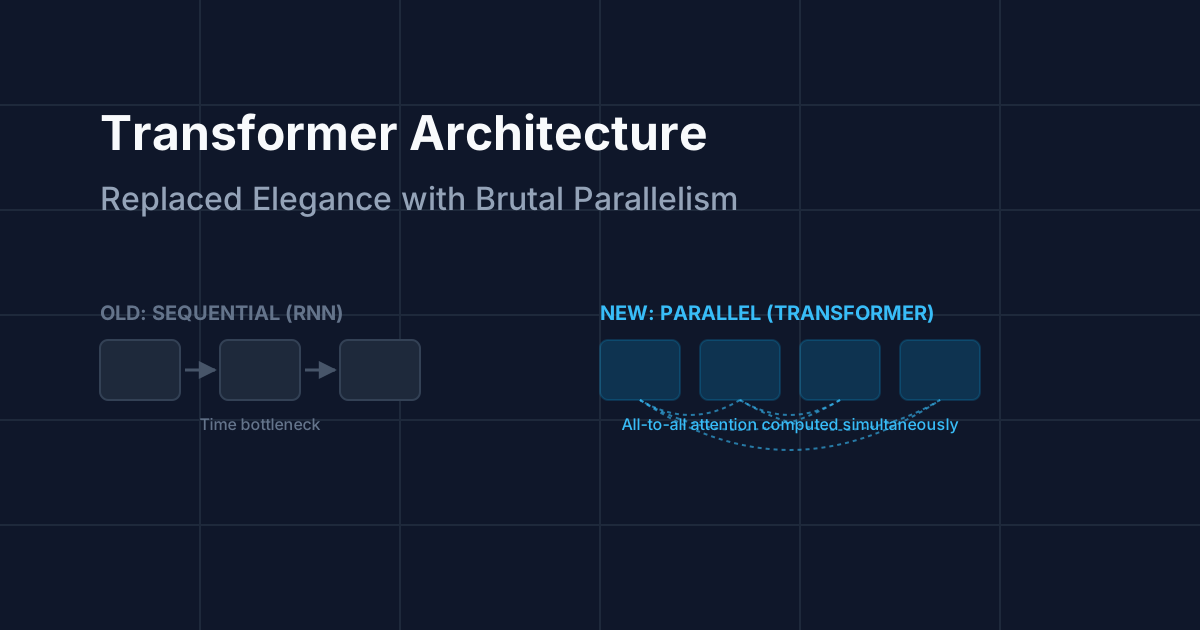
The defining breakthrough of the 2017 paper "Attention Is All You Need" wasn't just that it introduced self-attention. It was that it threw away the sequential processing of recurrent networks (RNNs) entirely. Instead of processing text word by word—an elegant but painfully slow method—the Transformer processes entire sequences at once.
The Trade-off: Inductive Bias for Raw Compute
Older architectures understood the order of text intrinsically because they processed it in order. The Transformer, by design, treats an entire paragraph as a bag of words processed simultaneously. To fix this, it injects positional encodings to mathematically remind the network where each token sits in the sequence.
Why make this trade? Because sequential processing cannot be easily parallelized on modern hardware. By ripping out the recurrence and replacing it with multi-head attention, the researchers created an architecture built to consume compute at an industrial scale. It traded human-like inductive bias for brute-force parallelism.
Why This Matters Today
The entire modern AI ecosystem—from massive LLMs like GPT-4 to advanced vision models—is built on this premise. The Transformer didn't win because it was the most mathematically elegant way to model language. It won because it was the first architecture that could efficiently digest the petabytes of data required to make language models actually work.
We are currently seeing efforts to replace it with state-space models and alternative architectures that promise better efficiency. But to beat the Transformer, a new model won't just need better math—it will need to map to hardware just as ruthlessly.
(Correct as of September 2026).