Comparison
Generative vs Discriminative
The difference between modeling how data was created versus modeling the boundary between classes.
Verdict: Discriminative models draw a line in the sand; Generative models build a topographic map.
Quick Version (TL;DR)
The difference between modeling how data was created versus modeling the boundary between classes.
The Short Answer
These two approaches solve problems differently based on what they actually learn from the data.
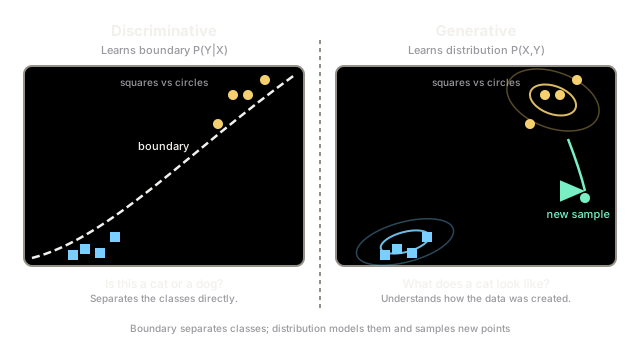
Discriminative Models learn the boundary between classes. They are highly focused on the task of classification. If you ask a discriminative model to tell a dog from a cat, it just looks for the specific features that separate them (like ear shape). It has no idea what a dog actually looks like holistically; it just knows how it differs from a cat.
Generative Models learn the actual distribution of the classes. They try to understand how the data was generated in the first place. If you show a generative model dogs, it builds a statistical representation of "dog-ness". Because it knows what a dog looks like, it can generate a completely new, fake image of a dog.
Where They Differ
| Feature | Discriminative | Generative |
|---|---|---|
| What it models | (Probability of Y given X) | (Joint probability of X and Y) |
| Visual Metaphor | Drawing a line between groups on a scatter plot. | Drawing contour lines (a topographic map) over each group. |
| Typical Goal | Classification or Regression. | Generating new data or outlier detection. |
| Examples | Logistic Regression, SVMs, Random Forests, Traditional CNNs. | Naive Bayes, Hidden Markov Models, GANs, Diffusion Models, LLMs. |
| Data Efficiency | Requires less data to achieve high accuracy on classification. | Requires massive amounts of data to model the full distribution accurately. |
The Mathematical Difference
To use formal notation:
- A Discriminative model learns the conditional probability . Given an image (), what is the probability that the label () is "Cat"?
- A Generative model learns the joint probability . It models the probability of seeing that exact image and that label existing together in the real world. By applying Bayes' theorem, you can still use a generative model for classification (), but you can also use it to generate new values.
Choose A When
(When to use Discriminative Models)
- You only care about prediction: If your sole goal is to classify emails as spam or not spam, you don't need a model that can write spam emails.
- You have limited data: Learning a simple boundary requires significantly fewer examples than learning the entire distribution of the universe.
- You need high accuracy on a specific task: Discriminative models almost always outperform generative models on strict classification benchmarks because they dedicate 100% of their capacity to finding the boundary.
Choose B When
(When to use Generative Models)
- You need to create new content: Writing text, generating images, or synthesizing voice.
- You have missing data: Generative models can "fill in the blanks" (imputation) because they understand the underlying distribution.
- You are doing anomaly detection: Because a generative model knows what "normal" data looks like, it can easily flag data that has a very low probability of occurring.
What People Get Wrong
Assuming Generative AI is entirely new
While Large Language Models and Diffusion models are recent, the concept of generative modeling is decades old. Naive Bayes, a classic algorithm from the 1950s used for spam filtering, is technically a generative model because it models the distribution of words.
Using Generative Models for simple classification
It is incredibly inefficient to use an LLM (Generative) to classify customer sentiment as "Positive" or "Negative". It's like building an entire replica of a city just to measure the distance between two buildings. Use a small, fast discriminative model instead.