Comparison
GAN vs VAE vs Diffusion
Comparing the three major paradigms of deep generative modeling for images.
Verdict: Use Diffusion models for the highest quality and diversity in image generation; use GANs when inference speed is strictly constrained; use VAEs when you need a structured latent space for smooth interpolation.
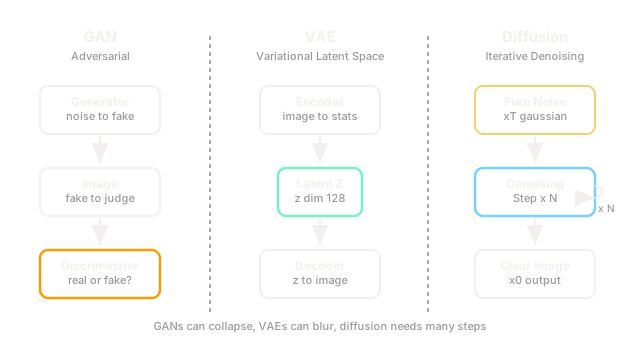
Quick Version (TL;DR)
Comparing the three major paradigms of deep generative modeling for images.
The Short Answer
Generative Adversarial Networks (GANs) pit two networks against each other to create realistic images in a single step. Variational Autoencoders (VAEs) compress images into a smooth statistical distribution to sample from. Diffusion models slowly destroy an image with noise and train a network to reverse that destruction step-by-step, currently dominating the state-of-the-art.
Where They Differ
| Feature | GAN | VAE | Diffusion |
|---|---|---|---|
| Mechanism | Adversarial (Generator vs Discriminator) | Variational (Encoder to latent space, Decoder to image) | Iterative (Add noise forward, remove noise backward) |
| Training Stability | Low (prone to mode collapse and oscillating gradients) | High (optimizes a clear mathematical bound) | High (stable regression task at each noise step) |
| Inference Speed | Very Fast (1 forward pass) | Very Fast (1 forward pass) | Slow (10 to 1000 forward passes required to denoise) |
| Image Quality | Excellent but often lacks diversity | Blurry compared to others | State-of-the-art (highest quality and diversity) |
Choose GANs When
- You need real-time generation: GANs generate an image in a single forward pass, making them the only viable choice for real-time video game textures, live face filters, or high-framerate video generation.
- You are doing paired image-to-image translation: Models like Pix2Pix (a conditional GAN) remain highly effective for strict mapping tasks like turning sketches into photos.
Choose VAEs When
- You need a highly structured latent space: If your application requires smoothly morphing between two images (interpolation) or explicitly controlling specific attributes (like changing a face's age), VAEs provide the most mathematically sound latent representations.
- You are building an intermediate compression layer: VAEs are heavily used inside other models (like Latent Diffusion) to compress images down to a smaller, manageable latent space before the heavy lifting begins.
Choose Diffusion When
- Quality and diversity are your primary goals: For text-to-image generation (Midjourney, DALL-E, Stable Diffusion), iterative denoising produces unmatched fidelity and easily handles highly diverse datasets without suffering from mode collapse.
What People Get Wrong
People often assume Diffusion models have made GANs and VAEs obsolete. This is false. Diffusion models are too slow for real-time applications where GANs still rule, and most high-resolution Diffusion models (like Stable Diffusion) actually run entirely inside the compressed latent space learned by a VAE. They are complementary, not mutually exclusive.