Comparison
Prompting vs RAG vs Fine-Tuning
Comparing the three primary methods for injecting knowledge or behavior into an LLM.
Verdict: Use RAG to give the model new facts; use Fine-Tuning to teach the model a new tone, format, or behavior; use Prompting to test the baseline before investing in either.
Quick Version (TL;DR)
Comparing the three primary methods for injecting knowledge or behavior into an LLM.
The Short Answer
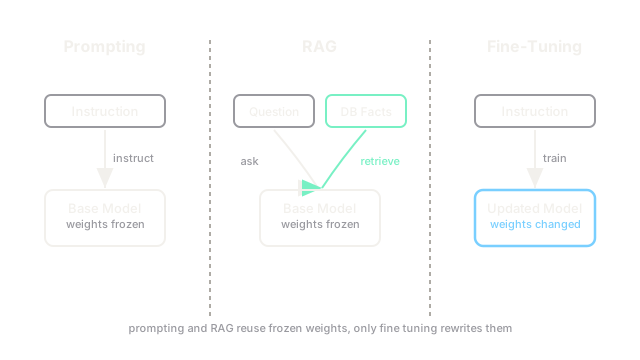
Prompting is simply asking the model to do something. RAG (Retrieval-Augmented Generation) searches an external database for relevant facts and pastes them into the prompt so the model can read them. Fine-Tuning actually updates the mathematical weights of the model by training it on thousands of examples of how it should behave.
Where They Differ
| Feature | Prompting | RAG | Fine-Tuning |
|---|---|---|---|
| Best Used For | General instructions | Supplying dynamic, external facts | Changing tone, style, or output format |
| Updating Knowledge | Hardcoded | Instant (just update the database) | Extremely slow (must retrain) |
| Cost | Free (time) | Moderate (database + embedding costs) | High (GPU training costs) |
| Hallucination Risk | High | Low (grounded in retrieved text) | High (model confidently invents facts) |
Choose RAG When
- You need the model to know private or changing facts: If you want a chatbot to answer questions about your company's HR policy, you must use RAG. Fine-tuning a model on facts is unreliable because LLMs act as lossy compressors; they will hallucinate numbers and dates. RAG forces the model to read the exact policy document.
Choose Fine-Tuning When
- You need the model to speak a specific way: If you need the model to consistently output valid JSON conforming to a strict schema, or to adopt the exact witty tone of your brand, fine-tuning on 1,000 examples will burn that pattern directly into the weights, saving you from writing massive 500-word prompts.
- You are optimizing latency and cost: A fine-tuned model doesn't need long, complex prompts to explain how to behave, saving you massive amounts of input tokens (and thus money and time) on every request.
What People Get Wrong
The most common and expensive mistake in generative AI is attempting to fine-tune an LLM to memorize a textbook or a database. Fine-tuning is for form; RAG is for facts. If the knowledge changes often or requires exact precision, do not touch the model's weights.