Comparison
Radiance Fields vs Gaussian Splatting
Comparing implicit neural rendering with explicit 3D Gaussian primitive rasterization.
Verdict: Use Gaussian Splatting for real-time rendering and fast training; use NeRFs when storage size is severely constrained or you need perfect continuous surfaces without artifacts.
Quick Version (TL;DR)
Comparing implicit neural rendering with explicit 3D Gaussian primitive rasterization.
The Short Answer
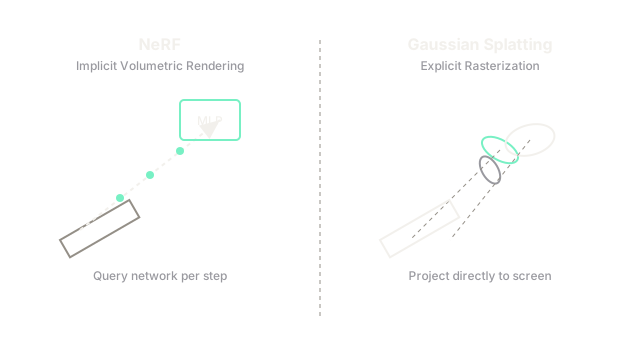
Neural Radiance Fields (NeRFs) represent a 3D scene implicitly as weights inside a neural network, requiring the network to be queried thousands of times per pixel to render an image. 3D Gaussian Splatting abandons the neural network entirely during inference, representing the scene explicitly as millions of 3D ellipsoids (Gaussians) that can be projected (splatted) onto a 2D screen using standard, ultra-fast GPU rasterization.
Where They Differ
| Feature | NeRF | 3D Gaussian Splatting |
|---|---|---|
| Representation | Implicit (Neural Network weights) | Explicit (List of 3D Gaussians) |
| Rendering Method | Volumetric Ray Marching (query network per ray step) | Rasterization (sort and project onto screen) |
| Rendering Speed | Slow (often fps without heavy caching) | Real-time ( fps at 1080p) |
| Storage Size | Small (a few megabytes for the network) | Large (hundreds of megabytes for millions of Gaussians) |
Choose A When
- You are constrained by storage size: A NeRF compresses the entire scene into the weights of an MLP, which can be just a few megabytes. Splatting requires storing position, color, opacity, rotation, and scale for millions of points, heavily ballooning file sizes.
- You need perfectly smooth, continuous surfaces: Because NeRFs are continuous mathematical functions, they excel at modeling specular reflections (like mirrors and water) and completely solid surfaces. Splatting can sometimes look "flaky" or fuzzy if viewed from an extreme angle not present in the training data.
Choose B When
- You need real-time rendering: Gaussian Splatting was designed specifically to utilize the rasterization pipeline built into modern GPUs. It is orders of magnitude faster to render than a standard NeRF.
- You need fast training: Splatting optimizes explicitly positioned points rather than backpropagating through a deep MLP for every ray step, cutting training time from hours down to minutes.
What People Get Wrong
People often think Gaussian Splatting is just a point cloud. Unlike a point cloud (which has empty gaps between points), 3D Gaussians have opacity and volumetric extent that overlap and blend together (alpha compositing). This allows them to render continuous surfaces and semi-transparent effects (like smoke) that traditional point clouds cannot.