Stakeholder Engagement for AI Teams
Labs cannot see how a model lands in clinics and queues. Engagement brings the people who live with the outputs into design, data and monitoring.
Why Does This Exist?
A lab team ships a triage helper trained on clean rows and tidy labels. In the clinic it meets night shifts, clipped speech and crowded waiting rooms. Nurses work around it within a week. Nobody asked them before launch, so the miss was guaranteed.
You cannot fix that with one more metric. The blind spot sits outside your logs: who the system touches, what they fear and which errors cost them most.
This page covers how to bring those people in early and keep them in after launch. Designing for the margins lives in inclusive ML. Turning their input into blocking checks lives in AI governance. How outsiders verify your claims lives in model auditing.
You need one idea first. A stakeholder is anyone who uses the system, is scored by it, or must defend it later. That includes direct users, affected communities, domain experts and auditors.
Think of It Like This
A bus route redrawn with riders in the room
Planners draw a fast new route on a clean map. It looks quick until riders speak: the night shift needs the hospital stop, wheelchair users need level boarding at two corners, and shop owners need the loading zone kept clear at noon.
The redrawn map is slower on paper and faster in life. Fewer missed transfers, fewer complaints, one route people actually ride.
Map it across: planners are your model team, riders are affected communities, drivers are domain experts, and the transit board is your auditor. Where it stops: riders name real pains but do not write loss functions, so you must still translate their needs into thresholds and tests.
How It Actually Works
Engagement is a loop, not a meeting. You map who is touched, you ask at each stage with a method that fits, and you give their input power to change the plan.
Let be the groups you must hear: users, affected communities, domain experts and auditors. Let be the four stages: design, data, evaluation and deployment. Input counts only when it can block, reshape or roll back work at .
Who joins at each stage
- Design. Ask whether the problem suits automation at all. Run a short workshop with community members and domain experts. If night-shift nurses say the helper adds clicks without cutting risk, pause or reshape the scope.
- Data and evaluation. Ask what your rows miss. Community reviewers flag proxy fields and missing dialects. External testers try to break the model on purpose. In our fixture 60 beta testers file 18 issue reports. That is , a 30 percent report rate.
- Deployment and watch. Keep the channel open after launch. Of those 18 reports, 6 change the model: 2 proxy fields blocked, 3 label rules fixed and 1 appeal added. That is , one in three reports acted on. Log each outcome with an owner.
Worked example with 60 testers
Sixty community testers use a hiring helper for two weeks. They file 18 reports: 7 about dialect misses, 6 about postcode proxies and 5 about opaque rejections.
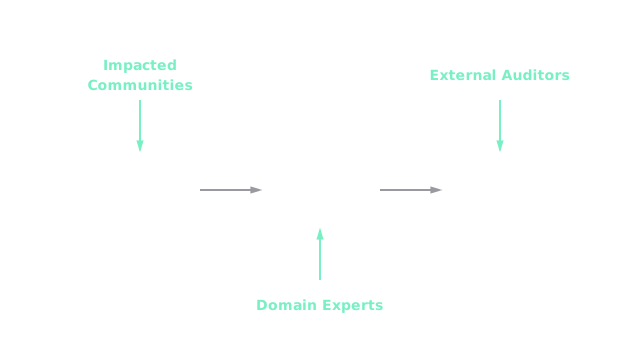
Triage keeps 6: block 2 postcode features, fix 3 text normalizers and add 1 appeal route. Report rate is . Action rate is . The diagram draws this exact funnel: three groups feeding four stages, with one loop marked 60 to 18 to 6. Without that loop the team would have tuned accuracy on the same blind data and called it done.
Watch Out For
Running engagement as theater
Symptom: one focus group late in the build, notes filed, roadmap unchanged. The launch post claims community input while testers watch their warnings ship anyway.
Fix: attach each finding to a gate with an owner and a date. If 6 of 18 reports warrant changes, schedule them before release or write why not, and share that log back with the testers.
Only hearing the loudest room
Symptom: feedback comes from power users on fast connections. Night shifts, non-native speakers and appeal filers stay silent, so dialect misses and postcode proxies survive your beta.
Fix: recruit by impact, not convenience. Pay testers, sample the quiet slices on purpose, and weight appeal cases higher than praise in triage.
The Quick Version
- Engagement brings users, affected communities, experts and auditors into every stage.
- Ask at design whether to automate, at data what rows miss, and after launch what broke.
- In our beta 60 testers file 18 reports, a 30 percent report rate.
- Six reports change the model: 2 proxies blocked, 3 labels fixed and 1 appeal added.
- One in three reports acted on keeps the loop honest.
- Input that cannot block, reshape or roll back work is theater, not engagement.