Transparency and Accountability in AI
Transparency shows how a model reached its call. Accountability names who owns that call and how to appeal it.
Why Does This Exist?
A loan model says no and the applicant asks why. The officer shrugs. The log holds a score with no reasons, no owner and no appeal route. That silence is the black box problem, and it bills real people.
You need two things at once. Reasons you can inspect, and a person or board who owns the outcome and can fix it. One without the other fails: reasons with no appeal help nobody, and an owner with no logs cannot prove a thing.
This page covers both halves: exposing reasons and assigning ownership. The math behind per-feature reasons lives in explainable AI. How outsiders test those reasons lives in model auditing. The data deal underneath lives in consent and data rights.
You need one idea first. An audit trail is a stored list of inputs, outputs, reasons and approvers for each decision. Without it, accountability is a slogan.
Think of It Like This
An open kitchen with a named manager
A closed kitchen sends out a dish that triggers an allergy. The waiter cannot say which cook, which ingredient or which ticket went wrong. You get an apology and the same risk next visit.
An open kitchen changes the outcome. You see the ticket rail, the allergy flags and who fired each pan. The manager owns the pass, can point at the missed flag and can comp, refire and retrain.
Map it across: tickets are inputs, flags are data sheets, cooks are model parts, and the pass is the release log. Where it stops: you can watch a cook while you cannot watch a weight matrix, so you rely on measured reasons and stored logs instead of sight.
How It Actually Works
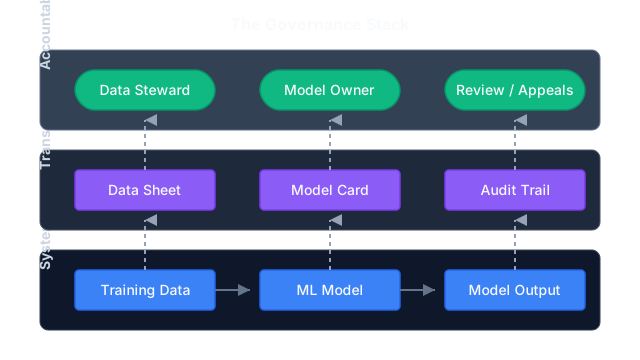
Transparency runs on three layers. Data sheets say what trained the model. Reason methods split one prediction into checkable parts. Logs store those parts with an owner and an appeal path.
Call the model output for one applicant . Call the base rate . Call each feature credit for feature . Additive reasons promise:
In words: is where you start, each is how much feature pushed this case above or below that start, and the sum lands exactly on the model score.
Worked example that sums to 0.60
Take a loan score with base rate . For one applicant the credits are income , debt and age .
Add in order:
So . The diagram draws this stack beside a hidden-logic panel: base plus income minus debt plus age landing exactly on 0.60, with an audit box and an appeal arrow attached. Income tops the list, debt is the only drag, and the parts reconcile with the whole, which is what an auditor replays.
Accountability closes the loop. The log stores the four credits, the data version and the approver name. The applicant gets the top reasons plus one action that would change the outcome, and a route to challenge the call within days, not months.
Code
Add the credits in points to dodge float wobble. Standard library only.
base: int = 40income: int = 25debt: int = -10age: int = 5pred: int = base + income + debt + ageprint(pred) # -> 60print(f"{pred / 100:.2f}") # -> 0.60Sixty points means . The print matches the hand sum . That equality is what makes the reason auditable.
Watch Out For
Quoting an approximation as the true reason
Symptom: a post-hoc chart looks clean at 0.60 with income on top, so the denial letter cites it as proof. A rerun with a new seed puts debt on top while the score never moves. The audit trail now contradicts itself.
Fix: fix the seed and sampling width, rerun several times, and use exact additive credits for compliance cases. Treat the chart as a description of the model, never a certificate for it.
Publishing reasons with no way to appeal
Symptom: the notice names income and debt correctly, yet offers no form, no timeline and no human reader. The system is transparent and still unaccountable.
Fix: ship the appeal with the reason. Name what to change, who reads the challenge and how fast they reply, and log the second decision beside the first.
The Quick Version
- Transparency exposes inputs, reasons and logs for each decision.
- Accountability names the owner and provides a real appeal route.
- Additive credits start from base 0.40 and sum exactly to 0.60.
- Our case runs 0.40 plus 0.25 minus 0.10 plus 0.05 equals 0.60, with income on top.
- Logs store credits, data version and approver beside every call.
- Reasons without appeal, and owners without logs, both fail the test.