3D Object Detection Boxes Guide
Draw boxes with length, width, height, and heading, not just rectangles. 3D detection lifts 2D finds into metric cuboids for driving.
Why Does This Exist?
Driving needs distance plus size plus direction: a 2D box cannot tell a truck beside you from a billboard ahead. 3D detection exists to output cuboids in meters that planners can avoid. It splits into LiDAR based precision and camera economy.
Two-dimensional basics are object detection; point data is point clouds. Key models are VoxelNet and PointPillars.
Think of It Like This
Parking with shoebox outlines
A parking camera draws shoeboxes around cars including which way noses point. Overlapping drawings fail the test; only snug oriented boxes pass.
Boxes are cuboids and overlap is 3D IoU. The analogy stops at height: cameras guess height while lidar measures it, which is why modalities differ.
How It Actually Works
Single-stage heads voxelize or pillar-encode clouds, run 3D or 2D backbones, then regress box residuals against anchors plus heading bins to handle angle wrap. Two-stage variants propose coarsely and refine with point-level features. Matching uses 3D IoU with thresholds for cars and for pedestrians on KITTI; bird's-eye-view AP simplifies height away for speed. Non-maximum suppression runs in 3D or BEV to prune duplicates.
Worked numbers
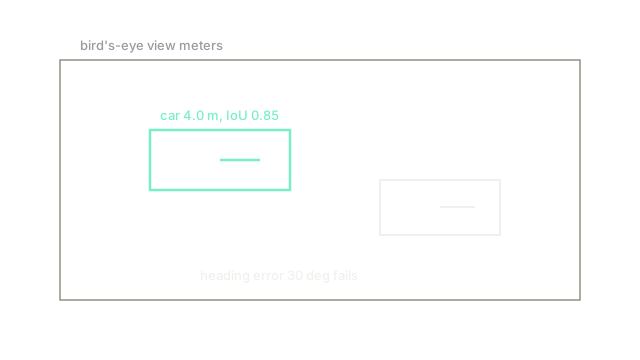
A m car predicted m short with perfect otherwise gives IoU about along length, passing . A -degree heading error on a m car drops IoU under and fails despite good center. Reference moderate car AP sits near percent lidar versus percent monocular.
Code
def iou_1d(a0: float, a1: float, b0: float, b1: float) -> float: inter = max(0.0, min(a1, b1) - max(a0, b0)) # overlap length union = (a1 - a0) + (b1 - b0) - inter return inter / union
print(round(iou_1d(0.0, 4.0, 0.6, 4.6), 2)) # -> 0.74Watch Out For
Judging 3D by 2D AP alone
High 2D AP with poor depth passes image tests while cars sit meters off. The symptom is great demos with harsh braking. Always report 3D IoU and BEV AP with heading included.
The Quick Version
- 3D detection outputs metric cuboids with heading angle.
- Lidar leads on accuracy; cameras lead on cost.
- 3D IoU at cars and pedestrians sets KITTI passing.
- Heading errors sink IoU faster than center errors.
- BEV AP drops height for fast planning scores.
- Report 3D metrics, never 2D alone, for driving.