LiDAR Based 3D Perception Guide
Spinning lasers paint exact points day and night. LiDAR perception turns those returns into boxes that cameras cannot match at range.
Why Does This Exist?
Cameras fail at night and guess depth; radar is coarse. LiDAR exists as the measured middle: active lasers return range plus intensity regardless of sun, feeding 3D object detection with metric truth. It costs more and hates rain, which is why fusion persists.
Detectors built on it are VoxelNet, PointPillars, CenterPoint, and SECOND. Points themselves are point clouds.
Think of It Like This
Bats flying with laser rulers
Bats click and hear walls in the dark. Give each bat a laser ruler that also reports wall paint brightness, and it maps caves at noon or midnight alike.
Clicks are laser pulses and echoes are returns. The analogy stops at weather: sound crosses fog while nm light scatters, so rain blinds lidar first.
How It Actually Works
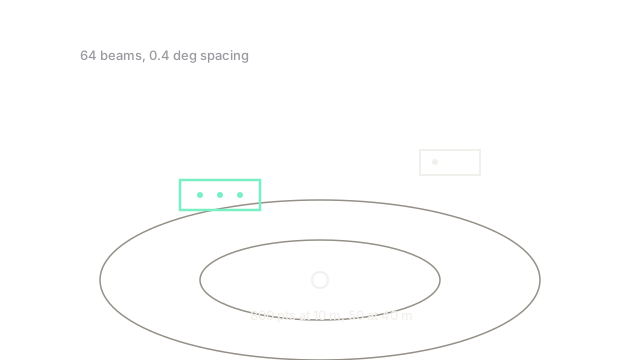
A -beam unit spins at Hz with vertical spacing about degrees, recording plus intensity and elongation per return. Density falls as : a car gives about points at m but at m since . Detectors voxelize, pillar-encode, or point-process these returns, then regress boxes with height from direct instead of guessing.
Worked numbers
Angular step degrees spans m at m ( rad) but m at m. A m tall car covers about beams near and far. Intensity on plates versus on tires separates parts before any network runs.
Code
def point_count(near: int, r0: float, r1: float) -> float: return near * (r0 / r1) ** 2 # inverse square thinning
print(point_count(800, 10.0, 40.0)) # -> 50.0Watch Out For
Trusting lidar in heavy spray
Rain and exhaust scatter returns into ghost points that detectors box as obstacles. The symptom is phantom braking in storms. Filter by intensity and multi-return flags, and lean on radar when spray peaks.
The Quick Version
- LiDAR returns measured range plus intensity day or night.
- Sixty-four beams at degrees set the angular grid.
- Density falls with range squared: near becomes far.
- Height comes measured, not guessed like cameras.
- Rain scatter creates ghost points to filter.
- Voxel, pillar, and point heads all start from these returns.