4D Scene Understanding
The world moves in three dimensions over time — four total. 4D understanding reconstructs scenes that stay consistent as viewpoints shift and seconds pass.
Why Does This Exist?
Static 3-D misses motion; video misses geometry. A NeRF freezes the dancer mid-leap; a video predictor paints the next frame with no notion of the body behind it. Editing ("remove the passerby"), AR anchoring ("the label stays on the mug"), and robot planning ("the door swings this way") need both: geometry that moves, tracked through time.
4D understanding reconstructs spacetime volumes — 3-D structure per instant with correspondences across instants — from multi-view or monocular video. Dynamic neural fields and 4-D Gaussians carry the torch. The generation sibling is physically grounded generation; the futures engine is video prediction.
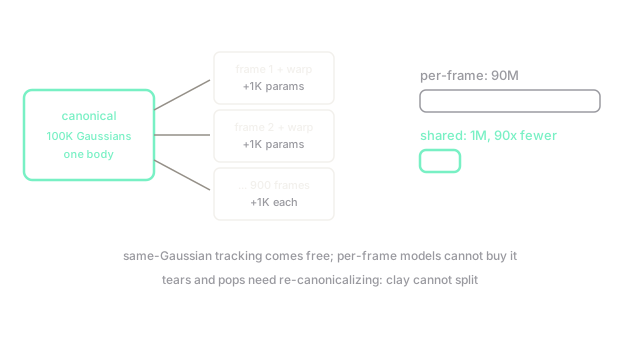
The one idea you need first. A canonical-plus-deformation model keeps one reference shape (the canonical dancer) and a per-frame warp field bending it into each instant's pose. Static parts cost nothing extra across time; only motion bills parameters. Correspondence comes free: the same canonical point tracked through warps is the same surface point forever.
Think of It Like This
A flipbook sculptor
A sculptor could carve each animation frame as a separate statue (per-frame reconstruction: accurate, enormous, no shared identity between poses). Or she sculpts one clay figure and photographs it bent into each pose (canonical plus deformation: one body, many warps, every mole tracked across frames).
4D methods are the clay approach. The canonical model is the sculpture; deformation fields are the posing hands. Per-frame carving wins on tearing and popping (clay cannot split), but pays full price per instant and forgets which mole is which.
How It Actually Works
Dynamic NeRFs condition radiance fields on time (latent codes per frame, or factorized space-time planes) and regularize motion (smoothness, rigidity priors, optical-flow consistency). 4-D Gaussian splatting moves the primitives themselves: each Gaussian drifts along a trajectory, densifying where motion complicates. Decomposition helps both: segment static background (reconstructed once, rigidly) from dynamic foreground (the expensive part). Monocular input leans on data-driven depth and motion priors; multi-view constrains directly.
Quality metrics span views (novel-view PSNR) and time (correspondence accuracy, warping error) — one axis alone certifies half the job.
Worked example
A -second clip at fps: frames. Naive per-frame models with Gaussians each: primitives — storage and optimization both drown.
Canonical-plus-deformation: canonical Gaussians plus frames deformation parameters . Ratio: . Ninetyfold fewer parameters, with correspondence (same-Gaussian tracking) that per-frame models cannot offer at any price.
Code
The point of this snippet is the sharing dividend: canonical plus warps prices a fraction of per-frame carving.
def primitives_per_frame(frames: int, per_frame: int) -> int: return frames * per_frame
def primitives_canonical(frames: int, canonical: int, warp: int) -> int: return canonical + frames * warp # one body, many poses
naive = primitives_per_frame(900, 100000)shared = primitives_canonical(900, 100000, 1000)print(naive, shared) # -> (90000000, 1000000)print(naive // shared) # -> 90Watch Out For
Topology changes that clay cannot follow
Tearing paper, pouring water, appearing objects: canonical maps assume one body bending, and splits/merges have no warp to describe them. Deformation fields stretch grotesquely across the tear while metrics average the damage into acceptability.
Detect topology events explicitly (tearing, contact changes) and re-canonicalize across them. Single-canonical models on splitting scenes produce rubber-world artifacts that no regularization smooths away.
Monocular depth-time ambiguity
One camera confounds motion toward the lens with growth, and deformation with viewpoint change: infinite scene-plus-motion pairs explain the same pixels. Priors pick one, sometimes the wrong one, with full photometric confidence.
Constrain with multi-view where possible; otherwise report the ambiguity (depth uncertainty alongside geometry) instead of a single crisp-but-wrong reconstruction. A confident wrong 4-D model misleads planners more than an honest uncertain one.
The Quick Version
- 4D understanding reconstructs moving 3-D scenes with correspondences across time.
- Canonical-plus-deformation shares one reference shape across frames via per-frame warps.
- The worked fixture compresses M per-frame primitives to M: fewer, with tracking included.
- Tearing and appearing objects break single-canonical maps; re-canonicalize across events.
- Monocular input confounds depth with motion, so constrain or report the ambiguity honestly.