Open Research Problems
Leaderboards saturate, yet street scenes still surprise. Open research names the gaps between benchmark wins and real understanding: generality, efficiency, truthfulness, and trust.
Why Does This Exist?
Benchmark curves flatten near while deployed systems keep failing: novel poses, rare conditions, confident hallucinations, irreproducible gains. The leaderboard measures a solved-looking slice; the street serves the unsolved remainder. Without a map of what is actually open, the field optimizes decimals on closed problems.
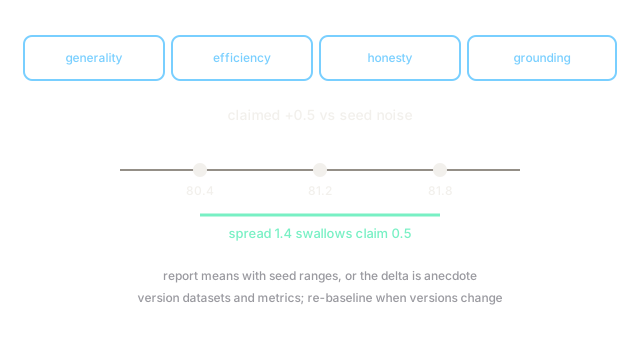
Open research organizes the remainder into four frontiers. Generality: one model for many tasks (unified models, generalist agents). Efficiency: eyes for labs without GPU-years (efficient pretraining, data-centric AI). Honesty: tests that resist gaming (benchmark design, hallucination). Grounding: scenes with time and physics (4D understanding, physically grounded generation) — all held together by reproducibility.
The one idea you need first. Seed noise is the spread of results across random training seeds: same code, same data, different dice. A claimed gain smaller than that spread is indistinguishable from luck. Reporting means plus ranges over three or more seeds is the minimum honest unit — everything below is anecdote with error bars missing.
Think of It Like This
A harbor chart, not the sea
Old charts mapped home waters precisely and marked the rest "here be dragons" — honest about the boundary between sounded and unsounded. Sailors who mistook the chart for the sea wrecked on unmapped rocks; those who read both sailed further.
Saturated benchmarks are sounded harbors: where the soundings exist. Open problems are the dragons: generality, grounding, truthfulness beyond the charted lanes. Progress means sounding new water (harder tests, shared standards), not re-measuring the harbor to another decimal.
How It Actually Works
Each frontier has a program. Generality builds shared backbones with task routing and instruction following, graded on breadth (worst-task scores, not averages). Efficiency buys eyes cheaply (masking, filtering, staging) and spends data quality over quantity. Honesty redesigns evaluation (contamination audits, prior-shifted splits, human-necessity tests) and penalizes fluent falsehood. Grounding adds time, depth, and physics to representations. Reproducibility wraps all four: seeds, code, data versions, and statistical comparisons as entry tickets.
No frontier advances on architecture alone; each is half measurement reform.
Worked example
A paper claims points from a new module. Reruns across three seeds give , , :
- Mean: .
- Range: points of pure seed luck.
- Claim sits inside noise spanning — the module's effect is unproven, whatever the headline seed scored.
Honest reporting shows seed spread with a significance test, or more seeds. The field's replication record suggests many published deltas live exactly here: real-looking, luck-sized.
Code
The point of this snippet is the noise check: mean and range decide whether a gain survives its own dice.
def seed_verdict(scores: list, claimed_gain: float) -> tuple: mean = sum(scores) / len(scores) spread = max(scores) - min(scores) return round(mean, 2), round(spread, 2), claimed_gain < spread
print(seed_verdict([81.2, 80.4, 81.8], 0.5)) # -> (81.13, 1.4, True)A True in the last slot means the claim drowns in noise: run more seeds or retract the delta.
Watch Out For
Leaderboard-chasing dressed as problem-solving
Decimal gains on saturated sets publish reliably and matter rarely: the test distribution is memorized, the errors are label noise, and the method transfers nowhere. Careers optimize what committees count, and committees count leaderboards.
Fund the dragons instead: pick one open problem, adopt its honest metric (worst-task, seed-tested, contamination-audited), and report there. A solved harbor decimal is worth less than a sounded channel.
Goalposts moved without version numbers
Benchmarks silently evolve (fixed labels, new splits, deduped tests) while papers compare across versions — gains that measure dataset edits, not methods. Unversioned evaluation makes history unreadable.
Pin dataset and metric versions in every result; re-baseline when versions change. A leaderboard without versions is a ruler made of rubber.
The Quick Version
- Four frontiers organize the unsolved: generality, efficiency, honesty, grounding — wrapped by reproducibility.
- The worked fixture shows seed spread swallowing a claimed gain; report means with ranges.
- Each frontier is half measurement reform: new tests and standards, not just new architectures.
- Saturated decimals transfer nowhere; fund dragon-sounding over harbor re-measuring.
- Version every dataset and metric, and re-baseline when versions change.