6D Pose Estimation
6D pose estimation reports where an object sits and how it is rotated, as 3D position plus 3D orientation for grasping and assembly.
Why Does This Exist?
A box says the drill is in view. The gripper needs the drill handle axis within degrees and millimeters to close without collision. 6D pose estimation exists to deliver that: three numbers for translation plus three for rotation , turning a known CAD model into an actionable grasp frame. Without rotation, every symmetric or articulated tool becomes a gamble.
For human joints see pose estimation and for boxes see object detection.
Think of It Like This
Fitting a key from its photo
You hold a key photo against the lock, sliding and turning your mental model until the teeth align with the pins. Translation is the slide, rotation is the turn, and the click is the fit. The model aligns rendered model points to observed pixels the same way. The analogy stops at keys: objects also hide half their teeth behind clutter.
How It Actually Works
A network predicts 2D locations of known 3D model keypoints or dense correspondences. Perspective-n-Point with RANSAC solves for and that best project model points onto observations. Here is a rotation and is a 3-vector in camera frame. A refinement step such as ICP on depth or render-and-compare tightens the fit. Symmetric objects need special losses that accept any equivalent rotation rather than punishing correct-but-rotated answers.
Worked example
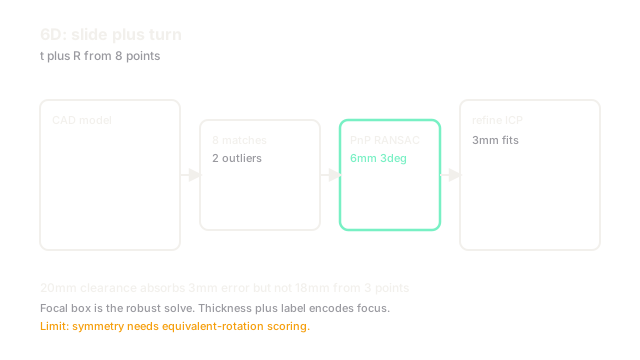
A mug 100 mm wide is viewed with 60 percent occlusion, leaving 8 reliable correspondences with 2-pixel noise. PnP plus RANSAC rejects 2 outliers and solves translation within 6 mm and rotation within 3 degrees. ICP on depth pulls translation to 3 mm. That residual fits inside a 20 mm gripper clearance, so the grasp proceeds. With only 3 correspondences the solve turns unstable and error triples, which is why visibility gating precedes grasping.
Code
This snippet solves translation from one correspondence given rotation.
import numpy as np
def translation_from_match(K: np.ndarray, R: np.ndarray, X: np.ndarray, x: np.ndarray, depth: float) -> np.ndarray: cam = R @ X ray = np.linalg.inv(K) @ np.array([x[0], x[1], 1.0]) t = depth * ray - cam return np.round(t, 2)
K = np.array([[500.0, 0, 320.0], [0, 500.0, 240.0], [0, 0, 1.0]])print(translation_from_match(K, np.eye(3), np.array([0.0, 0.0, 0.0]), np.array([320.0, 240.0]), 0.8)) # -> [0. 0. 0.8]Centered pixels at 0.8 m give pure forward translation. Real solves use many points plus robust rejection.
Watch Out For
Symmetry punished as error
A textureless cylinder looks identical after any spin about its axis, but naive rotation loss punishes all but one answer. The symptom is unstable training that never converges on bottles and shafts. The fix uses symmetry-aware losses that score the closest equivalent rotation or the closest-point distance instead of raw angle.
The Quick Version
- 6D pose is 3D position plus 3D orientation for a known model.
- Correspondences plus robust PnP give the first solve.
- Depth refinement tightens millimeters for grasping.
- Occlusion needs visibility gating; few points mean no grasp.
- Symmetry needs special losses that accept equivalent rotations.