Active Contours
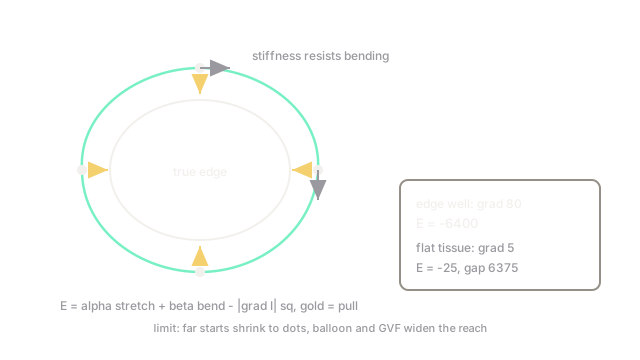
Drop an elastic loop near the target and let it slither onto the true edge, trading its own stiffness against the pull of image gradients until both forces balance.
Why Does This Exist?
Masks from thresholding or graph cut sit on the pixel grid, so curved anatomy like cell membranes and heart walls comes out staircase-jagged. Clinicians tracing organs want smooth, sub-pixel boundaries that follow the true edge. Active contours, nicknamed snakes since Kass, Witkin, and Terzopoulos (1988), give a curve that deforms itself onto the edge, smoothness built in rather than approximated afterward.
This page covers the parametric snake, its three energy terms, and the initialization trap. Pixel-labeling methods that need no starting curve are graph cut and GrabCut.
Think of It Like This
A glued rubber band on a relief map
Stretch a rubber band over a carved wooden relief map whose grooves are coated in glue. The band wants to shrink into a tight smooth ring, the glue grabs wherever the band touches a groove, and it settles where shrinking force and glue hold each other off, tracing the groove.
It stops holding over flat plains. Far from any groove there is no glue, so a band dropped in open country just shrinks to a dot. Real snakes share this myopia, which is why balloon forces and gradient vector flow exist to widen the glue's reach.
How It Actually Works
The curve and its three energies
A snake is a parametric curve with total energy
.
Elasticity punishes stretching and pulls the curve short; rigidity punishes bending and keeps it smooth; the external term pulls toward strong gradients. Minimizing by gradient descent moves each control point a little per step until internal stiffness and edge attraction balance.
Why gradients win, in numbers
The external energy is the negative squared gradient magnitude, so strong edges are deep wells. A point on a real edge with gradient magnitude sits at energy ; a point on flat tissue with magnitude sits at . The gap drags nearby control points downhill toward the edge, while and stop the curve from zigzagging between adjacent noisy maxima. High gives glassy-smooth curves that cut across corners; low follows every jag.
Initialization decides everything
Gradient descent only sees downhill locally, so a snake dropped far from the target shrinks to nothing or latches onto clutter. Standard practice starts from a coarse detection (a thresholded mask, a detector box) placed just outside the target. Balloon forces add a constant outward pressure so distant starts still expand toward edges, and gradient vector flow diffuses the edge field across flat regions so the pull reaches further.
Code
External energies for the two fixture points, showing the depth of the edge well:
edge_grad, flat_grad = 80.0, 5.0e_edge = -(edge_grad ** 2)e_flat = -(flat_grad ** 2)print(f"edge energy {e_edge:.0f}, flat energy {e_flat:.0f}, gap {e_flat - e_edge:.0f}")# -> edge energy -6400, flat energy -25, gap 6375A energy gap is what drags the snake onto the boundary.
Watch Out For
Initializing far from the target
Symptom: the curve collapses to a point or parks on background clutter, and no parameter tweak rescues it because the true edge lies outside the capture range. The snake is local optimization, not detection. Always seed from a coarse mask or box near the target, or add a balloon force or gradient vector flow field to extend the reach.
Bouncing off concave boundaries
Symptom: the contour bridges straight across indentations like the gap between fingers instead of diving in. Elasticity plus rigidity price sharp inward turns out of reach. Lower , raise the image-force weight, or switch to gradient vector flow, whose diffused field points into concavities that raw gradients cannot enter.
The Quick Version
- A snake minimizes elasticity plus rigidity plus negative gradient energy along a deformable curve.
- Strong edges are deep energy wells, while stiffness keeps the curve smooth and short.
- Initialization must start near the target because gradient descent only sees locally downhill.
- Balloon forces and gradient vector flow extend the capture range into flat regions and concavities.
- Use snakes for smooth precise boundaries; use graph-based labeling when no starting curve exists.