Aerial Object Detection
Aerial detection finds cars, ships, and sheds from drones and planes where objects are tiny, dense, and rotated any way the flight path left them.
Why Does This Exist?
Natural image detectors assume one big centered dog. Drone frames hold cars at pixels each, parked at every angle, under haze and motion blur. Downscaling the whole frame to network size shrinks each car to dust. Axis aligned boxes swallow rotated ships plus half the pier.
Aerial detection exists for that regime. Input is a large overhead frame plus ground sampling. Output is boxes with angle and class. The base skill is object detection; the fast single pass family is one-stage detectors. The map context is remote sensing.
Use it when targets are small, dense, and rotated. Use standard detection when objects fill a good share of the frame and stand upright.
Think of It Like This
Counting rice grains on a tablecloth
You cannot count rice from the doorway. You walk up, inspect one placemat at a time with overlap so edge grains are seen twice, and note each grain angle because they lie every way.
Tiling is walking up to each placemat. Overlap is the double look at edges. Oriented boxes are noting grain angle. The analogy stops at perspective: rice sits flat while buildings lean, so height adds a distortion grains never show.
How It Actually Works
Tile the frame into chips with pixel overlap, detect per chip, then merge across tile seams with non maximum suppression. Predict oriented boxes so a long ship at degrees gets a tight rotated rectangle instead of a loose axis box. Keep high resolution features alive for to pixel targets and match anchors to tiny scales. A pixel wide frame yields tiles before overlap math, and overlap adds edge duplicates the merger must resolve.
Worked example
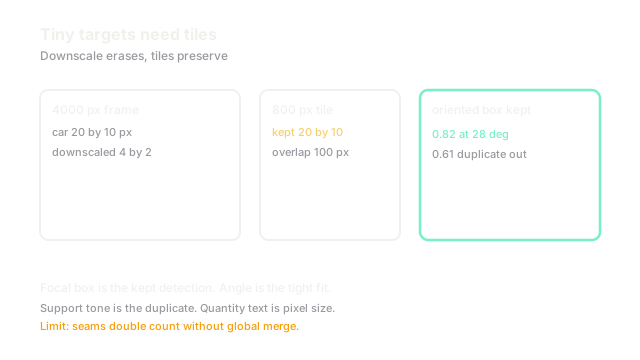
A car spans pixels at m sampling, about m long. Full frame downscale by times to pixels wide shrinks it to pixels, too small for any feature. An pixel tile at full resolution keeps intact. The detector fires at confidence with angle degrees. The same car split across two tiles fires twice; seam merging keeps the box and drops the duplicate by overlap.
Watch Out For
Tile seams that double count edge objects
Objects sliced by tile borders get two partial boxes that both survive when merger overlap is computed in chip coordinates. The symptom is paired detections marching along invisible grid lines. Fix it by merging in global frame coordinates with a overlap rule and by keeping the overlap wide enough for the largest target.
Axis boxes on rotated targets
An axis aligned box around a diagonal ship covers more water than ship, so training punishes good angle predictions and non maximum suppression keeps pier clutter. Fix it with oriented box heads and rotated overlap in both loss and suppression.
The Quick Version
- Aerial targets are tiny, dense, and rotated in huge frames.
- Tiling at full resolution preserves pixel cars that downscaling erases.
- Oriented boxes fit ships and planes tightly.
- The fixture keeps a box and drops its seam duplicate.
- Merge in global coordinates or grid lines become false counts.