Audio-Visual Sync Learning
Check whether sound and video come from one moment together. Sync plus separation teach hearing eyes.
Why Does This Exist?
Video holds free audio labels: matching sound must fit sight in time. Sync prediction plus sounding-object maps plus mix-and-separate train hearing eyes with no manual tags. Skills feed multimodal learning systems.
This page covers sight-sound links only. Text-video links are the alignment page.
The one idea you need first.
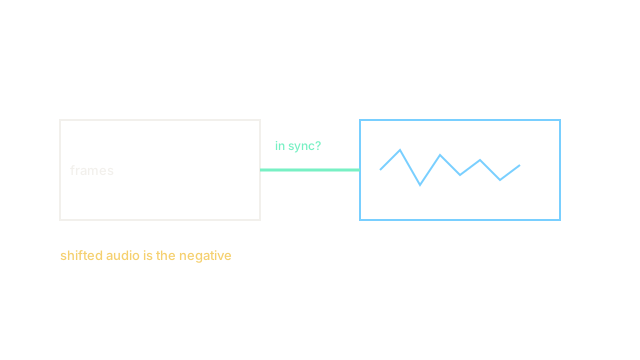
Sync score is high for true pairs and low for time-shifted . Sounding maps highlight pixels matching the sound. Separation masks split mixed audio by sight.
Think of It Like This
Checking dubbed movies for lip sync plus voices
A viewer spots bad dubs when lips miss words, picks who speaks in a crowd by mouth motion, and follows one voice at a loud table by watching faces. Sync, locate, and separate use sight plus sound.
Clips are scenes, shifts are bad dubs, and masks are focus. Where it stops: movies mix clean stems, while real clips add noise and echo.
How It Actually Works
Encode frames and spectrograms . Pay contrastive versus shifted . Localize by heatmaps. Separate by masks on mixed spectra with to clean targets. Train on VGG-Sound plus Kinetics clips.
In plain words: sync in time, point in space, and split by sight.
Worked example
True pair , shifted . Contrastive picks true at probability in batch . Guitar map IoU with truth box. Separated SDR rises dB over audio-only. Each number shows one facet of the link.
Watch Out For
Off-screen sounds breaking location maps
Narrators and background music have no pixels, yet maps still peak somewhere. False boxes score as hits. Gate sounding versus ambient with a presence head before trusting maps.
The Quick Version
- Audio-visual nets test sync against time-shifted negatives.
- Sounding maps point at pixels matching the sound.
- Sight-conditioned masks separate mixed audio.
- VGG-Sound plus Kinetics supply training clips.
- Presence gating handles off-screen sound.