Multimodal Learning Hub
Combine photos, words, sound, and video so answers use every signal. Joint models beat single senses on messy scenes.
Why Does This Exist?
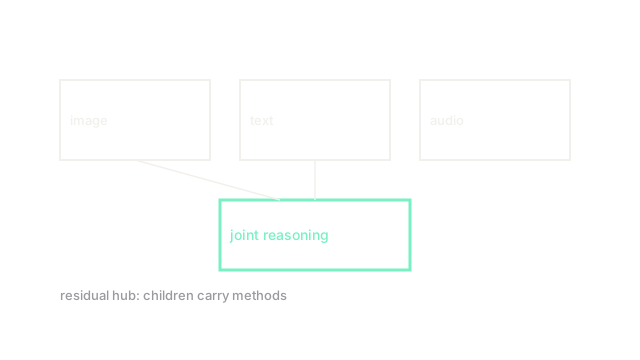
Real scenes mix sights, words, and sounds, yet single models miss cross clues like sizzling plus grill marks. Multimodal nets align and fuse signals for richer answers. This residual hub frames choices; methods live in audio-visual learning, alignment, retrieval, fusion, and video-language.
This hub builds on joint spaces from image retrieval.
The one idea you need first.
Alignment maps senses to one space; fusion mixes their features for answers. Shared encoders save weights while separate encoders protect specialties.
Think of It Like This
A kitchen crew tasting plus looking plus listening
A head chef tastes, watches color, and hears sizzle together. One sense alone misfires, but three agree on done. Tickets join the signals for timing.
Senses are encoders, the pass is fusion, and dishes are answers. Where it stops: kitchens share air, while models need paired data to link senses.
How It Actually Works
Encode each sense with . Align pairs contrastively, then fuse by concat, attention, or bottleneck for task heads. Train mixed batches across pair and joint tasks. Missing senses drop out during training for robustness.
In plain words: align first, fuse next, and test with senses missing.
Worked example
Cooking video: sizzle audio plus grill marks versus raw look alone. Fused done-score tops audio and vision . The point joint gain is why senses join.
Watch Out For
One loud sense drowning the rest
Text priors can override vision and models answer from words alone. Vision ablations then show no drop. Test with senses masked and balance batches before trusting joint scores.
The Quick Version
- Multimodal learning joins image, text, audio, video signals.
- Alignment maps senses together; fusion mixes them.
- Missing-sense training builds robustness.
- Children carry alignment, retrieval, fusion, video methods.
- Ablate senses to prove joint use.