Benchmark Design and Evaluation
Leaderboards steer the field, so their design is policy: what they measure becomes what models learn. Vision benchmark design builds tests that reward understanding instead of gaming.
Why Does This Exist?
Goodhart runs the field: when a measure becomes a target, models learn the measure. Texture shortcuts top photo benchmarks, language priors top VQA ones, and web-scraped pretraining drinks the test sets before evaluation day. Leaderboards keep crowning winners while understanding stands still — the test, not the training, failed.
Vision benchmark design is the residual this wave owns beyond the general components (see donor table): vision-specific hardening against saturation, contamination, and shortcut gaming. The data-quality ally is data-centric AI; the trust wrapper is reproducibility.
The one idea you need first. A visual-necessity split is a test subset provably unsolvable without the pixels (blind baselines score chance). A saturated benchmark is one where remaining headroom sits below the label-noise floor: further gains measure annotation luck, not methods. Contamination is test content inside training data, common at web scale. Design means engineering all three deliberately.
Think of It Like This
A driving test that only checks parking
A town tests drivers with parking alone: pass rates soar to , schools teach bumpers, and highways fill with licensed parkers who never merged. The test measured something real and optimized the wrong thing — every graduate is certified, none is qualified.
Vision benchmarks are driving tests. Accuracy on iid photos is parking: real, narrow, gameable. Necessity splits add the highway (can it merge across time, lighting, pose?), contamination audits check the examiner did not leak the route, and retirement schedules close test centers whose pass rates hit the noise ceiling.
How It Actually Works
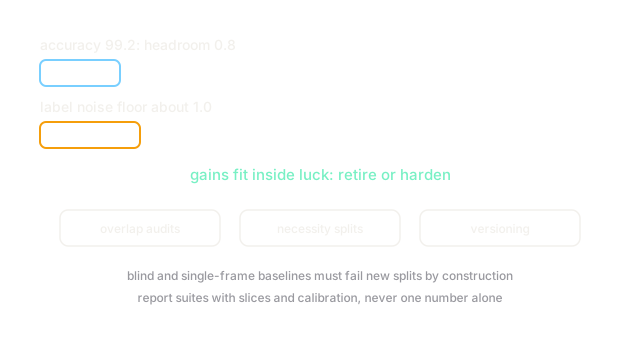
Hardening runs five moves. Headroom accounting: compare remaining error to estimated label noise; below parity, retire or harden. Contamination audits: clip-level dedup of training pools against every test item, published as overlap reports. Necessity splits: blind, single-frame, and text-only baselines must fail the new split by construction. Prior-shifted tests: reweighted positions, lengths, and phrasings that punish dataset-mean predictors. Versioning: frozen dataset-plus-metric releases with changelogs, so history stays comparable.
Report multi-threshold, multi-split curves: single numbers on single versions mislead by design.
Worked example
A classification benchmark sits at top-1. Headroom: points. Independent relabeling studies of similar sets typically find noise floors around point (disagreements, genuinely ambiguous images) — treat as the working floor, measured per set, never assumed.
Since , the remaining "progress" fits inside annotation luck: a claimed method gain cannot be distinguished from relabeling fortune. Verdict: retire the benchmark as a ranking device (keep it as a sanity check) or harden it with a necessity split where headroom reopens to tens of points.
Code
The point of this snippet is the retirement rule: headroom below noise means the leaderboard's ranking power is spent.
def benchmark_verdict(accuracy: float, noise_floor: float) -> str: headroom = 100.0 - accuracy if headroom < noise_floor: # gains fit inside annotation luck return "retire or harden" return "still ranks"
print(benchmark_verdict(99.2, 1.0)) # -> retire or hardenprint(benchmark_verdict(85.0, 1.0)) # -> still ranksWatch Out For
Web-scale training that drank the test
Pretraining lakes ingest benchmark footage (trailers, viral clips, dataset mirrors), and dedup at billion scale misses near-duplicates routinely. "Zero-shot" scores then price retrieval, and the contamination hides because nobody audits.
Mandate overlap reports per release: clip-hash the training pool against every test set and publish hit rates. No audit, no ranking claim — retrieval wearing generalization's clothes fools everyone exactly once per benchmark.
Single metrics that collapse judgment
One number (mAP, top-1) cannot span robustness, fairness, calibration, and efficiency — yet single-metric leaderboards pretend it does. Methods overfit the number's blind spots (confidence uncalibrated, tails abandoned, latency ignored) while climbing.
Report suites: accuracy plus slice breakdowns, calibration error, and cost. A champion that fails slices, lies about confidence, or needs a datacenter is three failures hiding behind one trophy.
The Quick Version
- This page owns the vision residual: saturation, contamination, and shortcut hardening beyond general design.
- The worked fixture retires a benchmark whose -point headroom sits below a -point noise floor.
- Necessity splits must fail blind and single-frame baselines by construction.
- Mandate training-vs-test overlap audits; retrieval is not generalization.
- Version datasets and metrics jointly; report suites, never single numbers alone.