Data-Centric AI
Models plateau while labels rot: mislabeled, duplicated, and biased images cap every architecture. Data-centric AI fixes the dataset instead of the network — often the cheaper win.
Why Does This Exist?
Architecture tweaks yield shrinking returns while datasets quietly rot: mislabeled images, near-duplicate leakage across splits, underrepresented slices, stale taxonomies. Models train on the rot and evaluations certify it — then teams tune hyperparameters against a ceiling built of bad labels. The model-centric loop polishes the wrong surface.
Data-centric AI inverts the loop: hold the model fixed, improve the data, measure. Cleaning, relabeling, deduping, and rebalancing routinely beat the next structural tweak at a fraction of the cost. Synthetic augmentation extends the same logic where collection stalls (see synthetic data generation). The evaluation sibling is benchmark design.
The one idea you need first. Confident learning finds mislabels without relabeling everything: cross-validated predicted probabilities flag images whose given label the model confidently rejects. Rank by self-confidence gap, review the top slice with humans, fix, retrain. A day of review regularly removes thousands of errors no architecture could route around.
Think of It Like This
A chef blaming knives for rotten produce
Dinner flops and the chef sharpens knives, buys pans, adjusts the flame — the model-centric loop. The carrots were rotten. No edge geometry rescues rot; the fix is sorting the produce, and it costs less than one copper pan.
Datasets are the produce delivery: some crates mislabeled (fish tagged fowl), some duplicated (same potato counted twice, once in training and once in the test), some slices missing (no winter vegetables at all). Data-centric work sorts crates. Sharpen knives after the produce is sound.
How It Actually Works
Audits run in passes: embedding nearest-neighbor search surfaces near-duplicates and split leakage; confident learning ranks likely mislabels for human review; slice metrics (per-class, per-attribute accuracy) expose underrepresented groups for targeted collection; versioned dataset releases pin every fix. Budgets split between relabeling (high-value slices first) and fresh collection (tail coverage). Benchmarks for the discipline fix models and grade datasets — the mirror image of classic leaderboards.
Synthetic data fills gaps collection cannot reach, priced against its own domain gap.
Worked example
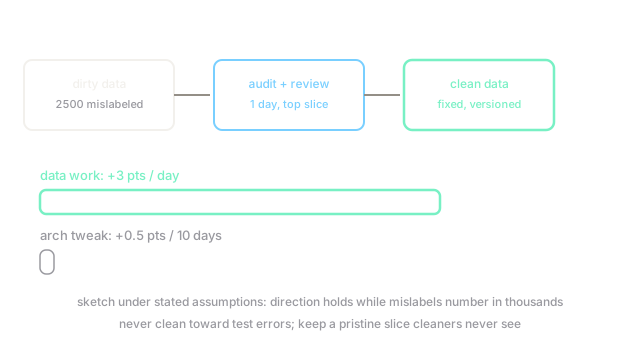
Budget sketch under stated assumptions: -image dataset with mislabeled ( bad labels). One review day clears the flagged top slice. Illustrative outcomes: cleaning lifts accuracy ( points); the competing architecture tweak gains at ten times the engineer cost.
Gain per cost tells the story: data work prices points per review-day; architecture work prices points per ten engineer-days — a difference in points per cost ( versus ). Real numbers vary by rot level; the direction rarely flips while mislabels number in the thousands.
Code
The point of this snippet is the triage math: count the rot, price the fixes, compare the rates.
def data_work_value(images: int, mislabel_rate: float, gain: float, cost_days: float) -> tuple: bad = int(images * mislabel_rate) return bad, round(gain / cost_days, 2) # bad labels, points per day
print(data_work_value(50000, 0.05, 3.0, 1.0)) # -> (2500, 3.0)print(round(0.5 / 10.0, 2)) # -> 0.05Watch Out For
Cleaning toward the test set
Review guided by test errors "fixes" exactly the images the benchmark checks — training on the test set through the data pipeline. Scores climb, generalization stands still, and the cleaned dataset generalizes worse than the dirty one did elsewhere.
Fix by principle (audits over the whole distribution), never by error file. Hold out a pristine evaluation slice the cleaners never see, and report it beside the main number.
Hard examples discarded as noise
Aggressive filters confuse difficulty with corruption: tail cases, rare poses, and ambiguous images score "low quality" and exit. The dataset gets cleaner and narrower, and tail performance — the deployment frontier — collapses precisely as averages rise.
Separate noise from difficulty: relabel the ambiguous, keep the hard, cut only the genuinely wrong. Track tail-slice metrics through every cleaning pass.
The Quick Version
- Data-centric AI fixes datasets with models held constant, inverting the usual loop.
- The worked sketch finds bad labels in images, pricing points per day against .
- Confident learning ranks mislabels for review; embedding search catches duplicates and leakage.
- Never clean toward test errors; hold a pristine slice the cleaners never see.
- Relabel the ambiguous and keep the hard; cutting difficulty as noise collapses the tail.