Beta-VAE
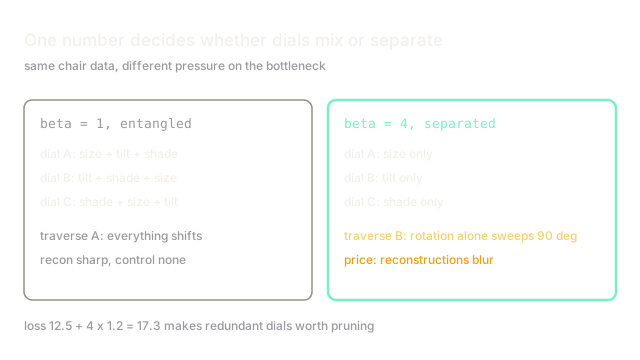
Beta-VAE turns up the pressure on the latent bottleneck past the standard setting, so each latent dial ends up controlling one separate visual factor.
Why Does This Exist?
Standard VAEs mix everything together. One latent dial changes pose and lighting and smile at once, because nothing in the objective asks different dials to mind their own business. For controllable generation that entanglement is fatal: you cannot ask the model for the same face with a different rotation.
Beta-VAE adds exactly one ingredient, a weight on the KL term, and the bottleneck tightens. With less information allowed through, the network spends its budget on the statistically independent factors of the data first, and those land on separate dials. Traversal becomes meaningful: move dial three and only the rotation changes. The standard-pressure version it modifies is the variational autoencoder, and the discrete alternative to this whole family is VQ-VAE.
Think of It Like This
Packing two suitcases with a strict weight limit
Two travellers share one tight weight allowance. If the limit is generous, both toss clothes randomly into both bags and neither bag means anything. Tighten the limit hard and they are forced to specialise: one bag takes all the heavy shoes, the other takes clothes, because mixing wastes precious kilograms on redundancy.
Beta is the weight limit. A loose bottleneck lets factors smear across dials; a tight one forces the shoes-into-one-bag split. Overpack past the limit and something gets left behind entirely, which is the blurry-reconstruction price below.
How It Actually Works
The objective is the VAE loss with one extra number:
is the encoder distribution, one Gaussian per latent dial with its own mean and variance, and is the unit Gaussian prior pulling every dial toward zero mean and unit variance. At this is a standard VAE. Common choices are for balanced results and higher values when disentanglement matters more than sharpness.
Why pressure separates factors
The KL term charges per dial for deviating from the prior. Smearing one factor across three dials pays the charge three times; isolating it on one dial pays once. Gradient descent, always economical, consolidates. Independent factors of the data, pose versus identity versus lighting, separate because sharing dials costs extra KL with no reconstruction benefit.
Worked example
Suppose reconstruction error is and total KL is . At the loss is ; at it is . The optimiser now gladly sacrifices of reconstruction to kill of KL, since saved beats lost. Dials carrying near-duplicate information get pruned to the prior first, and traversal of a surviving dial sweeps one factor: dial two from to rotates a chair render through degrees while size and colour stay fixed.
Code
Beta-VAE loss in four lines, showing how one number reweights the tradeoff.
def beta_vae_loss(recon: float, kl: float, beta: float = 4.0) -> float: """Reconstruction plus beta-weighted KL penalty.""" return recon + beta * kl
print(beta_vae_loss(12.5, 1.2, beta=1.0)) # -> 13.7print(beta_vae_loss(12.5, 1.2, beta=4.0)) # -> 17.3Watch Out For
Posterior collapse at high beta
Push to on a complex dataset and the KL term wins outright: every dial snaps to the prior, the decoder ignores the latent code, and every input reconstructs as the dataset average. Traversal does nothing because the dials carry nothing.
Raise in steps and watch reconstruction error. If it jumps while samples turn samey, capacity already collapsed. Annealing from upward during training avoids most collapses.
Calling entangled dials disentangled without traversing
A low KL number does not prove separation. The only test is traversal: sweep one dial across , hold the rest fixed, and check that exactly one visual factor changes.
If rotation and size move together, the dials are still entangled whatever the loss says. Report traversals as images, never as scores alone.
The Quick Version
- Beta-VAE is a VAE with the KL penalty multiplied by , often .
- Tight capacity forces statistically independent factors onto separate latent dials.
- Our example: turns loss into , making redundant dials worth pruning.
- Traversal of one dial should change exactly one factor, like rotation alone.
- Too much pressure collapses every dial to the prior, and blur is the standing price of separation.