Causal Representation Learning
Observing that beaches predict boats is not knowing. Causal features stay right when an intervention repaints the background, because they track the object rather than its surroundings.
Why Does This Exist?
Training minimizes error on the data it saw. When every boat photo has water behind it, water predicts boats perfectly, and the cheapest features a network can learn are water detectors. Deployment then punishes the shortcut with boats on trailers classified as cars.
Causal representation learning breaks the shortcut by training and testing under interventions: deliberate changes to context that should not change the label. Features that survive interventions earn the name causal; features that swing with context are flagged spurious. The umbrella map is causal and structured vision; this page covers the feature half.
Think of It Like This
A lighthouse test for sailors
A sailor who steers by harbor lights sails well until visiting a new port with different lights. A sailor who steers by compass and stars keeps course anywhere. The harbor board tests both by blacking out the harbor lights for a night: the first sailor drifts, the second holds.
Interventions are that blackout. Recoloring backgrounds or swapping scenes turns off the harbor lights of the dataset. Plain features drift; causal ones hold. The analogy stops at labels: sailors know their destination, while interventions need curated pairs or simulators to know what should have stayed fixed.
How It Actually Works
Build pairs that share the object but differ in context: same animal on grass versus sand, same digit on new colors. Train with an invariance penalty that forces one feature branch to predict the label identically across pair mates, while a second branch may absorb context. At test time, decide from the invariant branch. Counterfactual checks then edit one factor (repaint the sea) and confirm the prediction barely moves.
Worked example
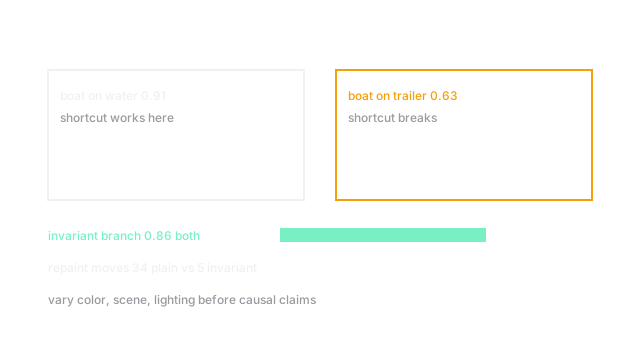
A demo set holds 160 boat images, half on water and half on trailers in lots. Plain features score 0.91 on water but 0.63 on trailers, a 28-point shortcut penalty. The invariant branch scores 0.87 on water and 0.86 on trailers: one point of swing instead of 28. Repainting the sea pink moves plain predictions on 34 of 80 images but moves the invariant branch on only 5. The gap between 34 and 5 is the evidence the split is genuine.
Watch Out For
Calling held-out robustness a causal proof
A model that survives one new background may fail the next, because the test covered one intervention, not the mechanism. The symptom is a causal badge over a single swap benchmark. Vary the intervention type (color, scene, lighting) before claiming invariance.
The Quick Version
- Correlations predict the label in training; interventions reveal which ones break.
- Causal features predict identically across context-swapped pairs.
- On the demo boats plain accuracy swings 28 points while invariant features swing 1.
- Repaint tests move 34 plain predictions against 5 invariant ones.
- One swap is robustness evidence, not a causal proof.