Domain Generalization for Vision
Train across several source domains with invariance pressure, so the model holds up on a domain it has never seen.
Why Does This Exist?
Sometimes no target image can be had at any stage: a future hospital, next year's sensor, a city not yet mapped. Adaptation is then off the table by definition. Domain generalization trains on multiple source domains at once with pressure to keep only the features that behave identically everywhere, betting those stable features survive the next unseen domain.
It is preparation, not repair, and it trails every method that sees target data. The umbrella framing is generalization and adaptation.
Think of It Like This
Studying past exams from many teachers
A student prepares for an unknown examiner by working past papers from five different teachers and keeping only the techniques that score under all of them. Teacher-specific tricks get dropped even when they are locally brilliant. The analogy stops at coverage: exam syllabi overlap by design, while visual domains can differ in ways no source collection spans.
How It Actually Works
Pool several labeled source domains and train the classifier with an added invariance term: penalize feature directions whose behavior differs across domains, or penalize accuracy gaps between domains, keeping one shared model. At deployment the model runs frozen on the unseen domain. Variants add cross-domain augmentation or style randomization to widen the spanned space without new collection.
Worked example with recomputed numbers
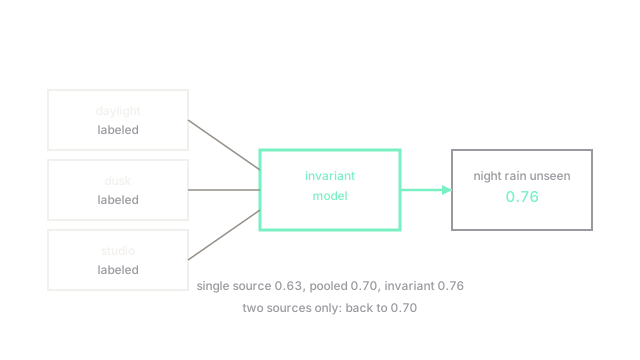
Train on three source domains, daylight, dusk, and studio, and test on unseen night rain. Single-source daylight training scores 0.63 there. Pooled multi-source training without invariance reaches 0.70. Adding the invariance term at matched weight lifts the unseen score to 0.76, a gain of 0.06 over pooling from pressure alone. Drop one source so only two remain and the unseen score falls to 0.70, showing diversity, not the penalty, carries most of the effect.
The limit to state plainly
Generalization cannot span variation absent from every source. When the unseen domain introduces a genuinely new corruption, scores revert near the single-source level regardless of penalty weight. Name the spanned axes per deployment and recollect when the new axis falls outside them.
Watch Out For
Tuning the penalty on the test domain
Choosing the invariance weight by peeking at the unseen domain turns the experiment into adaptation with extra steps and inflates the reported 0.76. The symptom is weights that fail on the next unseen site. Tune by leaving one source out and validate on it, then freeze before touching the true unseen set.
The Quick Version
- Trains on several sources with invariance pressure, no target data ever.
- The worked unseen domain moves 0.63 to 0.76, most of it from diversity.
- The penalty adds about 0.06 over plain pooling here.
- Source diversity is the ceiling; penalties only spend it well.
- Freezing before the unseen set is what keeps the claim honest.