CIFAR Small Natural Images
Small color photos in ten or one hundred classes, the step after MNIST where background and texture start to matter.
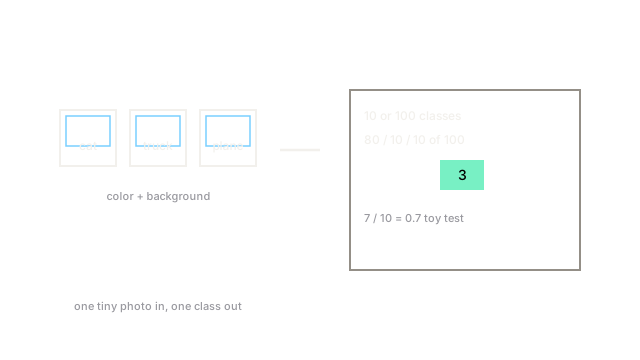
Why Does This Exist?
MNIST is too clean: centered, grayscale, no background. Real photos have clutter, lighting shifts and small objects. CIFAR keeps images tiny so experiments stay fast, but switches to color photos of animals and vehicles where context matters. It is the usual second baseline before ImageNet scale work.
This page covers purpose, I/O contract, a toy split walkthrough and failure modes. Cleaning practice is in dataset preparation.
Think of It Like This
Pocket photos instead of flashcards
MNIST flashcards are clean and centered. CIFAR is a pocket album: small snaps of cats, trucks and planes taken in the wild, still one label each but with messy backgrounds.
Same deck rules, harder pictures. Ten broad piles, or one hundred fine piles when you want confusion between similar kinds.
How It Actually Works
Purpose is small natural-image classification. Input is one color image, output is one class index. CIFAR-10 uses ten broad classes, CIFAR-100 uses one hundred fine classes grouped into twenty coarse groups. Appropriate use is fast architecture checks and teaching. Do not use it to claim real-world robustness, because tiny resolution hides detail that larger images keep.
Toy split walkthrough
Take 100 cards with 10 classes balanced, so 10 per class. Split 80 train, 10 validation, 10 test. That leaves about 8 train and 1 test per class. If the model gets 7 of 10 test right, accuracy is . Error analysis then asks which classes confused, for example cats versus dogs, rather than reporting the single number alone.
Code
Check the expected tensor contract without downloading anything.
import numpy as np
def batch_accuracy(pred: np.ndarray, true: np.ndarray) -> float: return float((pred == true).mean()) # fraction correct on the batch
pred = np.array([0, 1, 2, 1, 0, 3, 3, 2, 1, 0])true = np.array([0, 1, 1, 1, 0, 3, 2, 2, 1, 0])print(f"{batch_accuracy(pred, true):.1f}")# -> 0.8Eight of ten right gives 0.8, the same ratio used on the full fixed test split.
Watch Out For
Tuning tiny-image tricks that do not transfer
Heavy upsampling hacks and tiny-kernel tweaks lift CIFAR scores but stall on larger photos. The symptom is a leaderboard gain that vanishes at higher resolution. Fix it by validating design choices on larger images before adopting them.
The Quick Version
- CIFAR maps one tiny color photo to one class, in 10-class or 100-class form.
- Input is a color tensor, output is a single class index.
- A toy 80/10/10 split of 100 cards gives 8 train per class and accuracy as correct over 10.
- Use it for fast checks after MNIST and before large-scale data.
- Tiny resolution hides fine detail, so do not claim robustness from it alone.