Contrastive Loss Pairs Training
Contrastive loss trains on pairs, pulling same-class embeddings together while pushing different-class pairs beyond a safety margin.
Why Does This Exist?
Metric learning needs a concrete rule for shaping space, and pairs are the simplest unit: two items, same or different. Contrastive loss exists as that rule. It converts each labelled pair into a gradient that tightens matches and separates mismatches past a margin, which trains the siamese networks behind early face verification, signature matching and self-supervised pretraining. Triplets extend the idea in triplet loss.
Think of It Like This
Springs and bumpers between desks
Picture every embedding as a desk on wheels. Same-class pairs connect with springs pulling them together; different-class pairs get bumpers that shove only when desks come within the margin distance, ignoring pairs already far apart. Training shakes the room batch by batch until springs rest short and bumpers rest untouched. The analogy stops at the symmetry: real optimization moves network weights, not desks, and every pair shares one global layout.
How It Actually Works
For a pair with Euclidean distance d and label y (1 for same, 0 for different), the loss is 0.5 x d squared for same pairs and 0.5 x max(0, margin - d) squared for different pairs. Same pairs always attract; different pairs repel only inside the margin, so well-separated negatives cost nothing and training focuses on the confused middle.
A worked batch of two
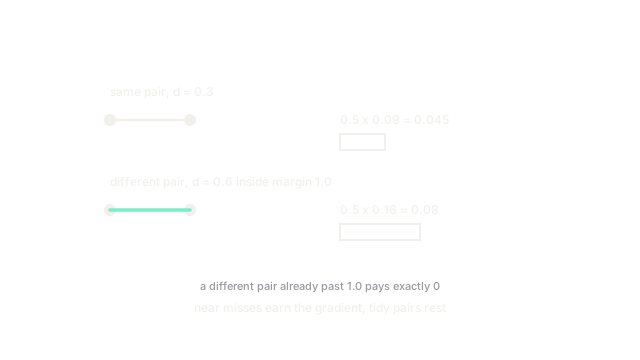
Same-class pair at distance 0.3 contributes 0.5 x 0.09 = 0.045. Different-class pair at distance 0.6 with margin 1.0 contributes 0.5 x (0.4) squared = 0.08. The confused negative outweighs the tidy positive, which is the intended pressure: the loss spends its gradient separating near-misses rather than polishing already-tight clusters. A different pair already 1.2 apart would contribute exactly 0.
Watch Out For
A margin that fights your threshold
The margin sets the scale of the whole space, and verification thresholds tuned for one margin misfire under another. The symptom is a model with clean training curves whose serving accuracy collapses at the old threshold. Fix it by calibrating the operating threshold after training, on held-out pairs, every time the margin changes.
The Quick Version
- Contrastive loss trains on labelled pairs: attract matches, repel close mismatches.
- Different-class pairs beyond the margin cost zero, focusing effort on near-misses.
- It powers siamese networks for verification and self-supervised pretraining.
- The margin defines the space's scale, so recalibrate thresholds whenever it changes.
- Hard-pair mining matters because random pairs are mostly already satisfied.