Feature Extraction Turns Pixels Into Clues
Feature extraction compresses millions of raw pixels into edges, textures and compact vectors, so a classifier learns from the clues instead of drowning in the grid.
Why Does This Exist?
A computer never sees a cat, only a grid of millions of pixel intensities. Training directly on those raw numbers fails twice: the compute is enormous, and the numbers are brittle, since a small lighting shift or a one-pixel translation rewrites them. Feature extraction exists to replace the grid with clues: edges, corners and textures that survive those shifts. How the sliding operation itself works lives in convolutional layers, and reusing another model clues is covered in transfer learning.
Think of It Like This
The police sketch artist
A witness never recites a face millimeter by millimeter. They report the defining clues: thick arched brows, a prominent jawline, a scar on the left cheek. The sketch artist turns those clues into one drawing, and the police search from the drawing instead of from pores.
Pixels are the millimeter recital, the extractor is the artist, and the feature vector is the sketch. Where it stops: a witness chooses clues on purpose, while a filter only fires where its arithmetic says so, which is why the wrong kernel sketches the wrong suspect.
How It Actually Works
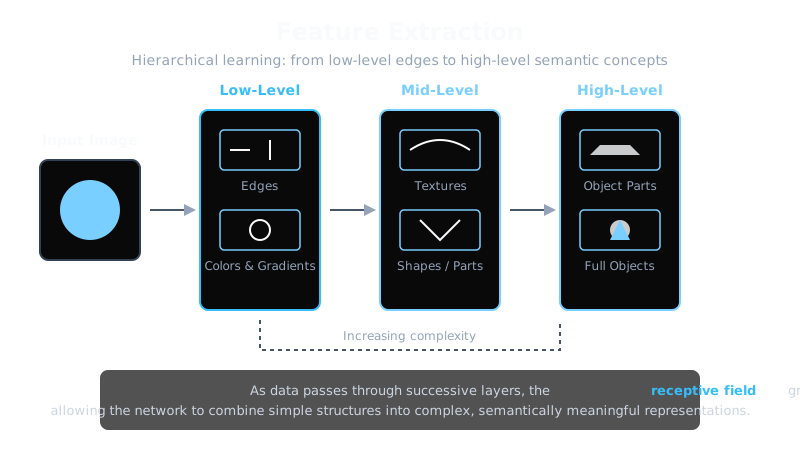
Extraction runs in two eras with one idea: keep what distinguishes, drop what repeats. Hand-crafted extractors were programmed patterns: edge filters such as Sobel and Canny flag sudden intensity jumps, corner detectors flag edge intersections, and descriptors such as SIFT and HOG summarize the texture around each keypoint so it survives scaling and rotation. Learned extraction replaced the programming: convolutional layers stack so early filters find lines, middle ones combine lines into textures and parts such as wheels or eyes, and late ones pool everything into a dense vector, say 128 numbers, that a classifier reads. Frozen backbones in pretrained models are this hierarchy reused: keep the learned clues, retrain only the final decision.
Worked example
Slide the vertical Sobel kernel over one 3 by 3 patch with a hard vertical edge. The patch rows are , , : dark paint left, bright paint right. The kernel is on the top row, in the middle, at the bottom. Multiply and add column by column: the left column contributes , the middle contributes 0, and the right contributes . The response is , a loud edge. On a flat patch of all 10s the same arithmetic gives : uniform paint cancels exactly, which is why the kernel ignores lighting flats and fires only on boundaries.
Code
The snippet below recomputes both worked responses with only the standard library.
sobel = [[-1, 0, 1], [-2, 0, 2], [-1, 0, 1]]edge = [[10, 10, 90], [10, 10, 90], [10, 10, 90]]flat = [[10, 10, 10], [10, 10, 10], [10, 10, 10]]
def respond(patch): """Slide-equivalent: one position, elementwise multiply and sum.""" return sum(patch[r][c] * sobel[r][c] for r in range(3) for c in range(3))
print(respond(edge)) # -> 320print(respond(flat)) # -> 0The edge scores 320 while the flat patch scores 0. Every feature map in a CNN is this loop repeated at each position with a learned kernel instead of a programmed one.
Watch Out For
Pooling away the signal too early
Aggressive downsampling or too few filters in the first blocks throws away the detail the task needs. The symptom is a model that confuses striped shirts with barcodes: both survived as bare edges because texture never got recorded. Fix it by widening early channels and delaying the first heavy pooling step, checking that validation separates your hardest pair before compressing further.
Assuming simple filters survive rotation
A vertical-edge kernel rotated 90 degrees sees a horizontal edge as flat paint, scoring near 0 on the structure you wanted. The symptom is accuracy that collapses on tilted or upside-down inputs while upright test images score well. Fix it with rotation-robust descriptors such as SIFT, or with augmentation plus learned filters that have seen every orientation in training.
The Quick Version
- Raw pixels are too many and too brittle, so extraction replaces the grid with clues.
- A vertical Sobel kernel scores a hard edge at 320 and flat paint at 0.
- Hand-crafted filters program the patterns; CNNs learn them from lines up to object parts.
- Late layers pool clues into a compact vector, such as 128 numbers, for the classifier.
- Frozen pretrained backbones reuse that hierarchy instead of relearning it.