CycleGAN
CycleGAN translates between image domains with no paired examples by forcing round trips, horse to zebra and back, to land where they started.
Why Does This Exist?
Paired data is a luxury. Nobody can photograph the same street as both a Monet painting and a snapshot, yet that translation is exactly what users want. Pix2Pix refuses such tasks outright: no pairs, no training.
CycleGAN replaces pairing with a round-trip promise. Two generators translate in opposite directions and two critics judge each domain, while a cycle loss demands that going there and back returns the original. Content survives because anything the forward trip destroys cannot be rebuilt on the return. The family umbrella is image to image GANs.
Think of It Like This
Two translators checking each other's work
An English-to-French translator and a French-to-English translator sit back to back with no bilingual dictionary. The only rule: translate a sentence to French and back, and the English must match the original. Neither can drift into creative rewriting, because the partner must reconstruct from whatever they produce.
Each translator is kept honest by the round trip, not by a answer key. The arrangement fails when both agree on a convenient lie, mapping every sentence to the same bland phrase that round-trips perfectly, which is the steganography pitfall below.
How It Actually Works
Generator maps domain to , generator maps back to . Discriminator tells real from ; tells real from . Three losses run together:
The cycle weight typically dominates. An optional identity loss feeds real into and asks for back unchanged, which preserves colours when domains share palette structure, like photo to painting.
Why the round trip preserves content
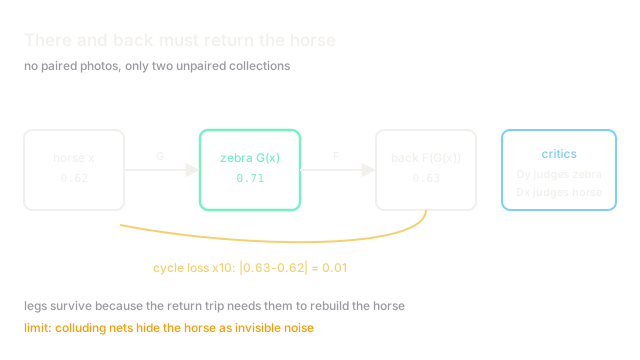
Adversarial losses only demand plausible zebras, and a zebra-textured horse silhouette with scrambled legs would pass. The cycle term ties outputs to inputs: legs must survive because the return generator needs them to rebuild the horse. Structure rides through translation as the information the return trip requires.
Worked example
A horse pixel becomes zebra and returns as . Cycle error is , times gives of loss pulling the pair toward exact inversion. Across millions of pixels that pressure is what keeps zebra stripes painted onto the horse's body rather than onto a rearranged animal.
Code
Cycle loss on a toy round trip, the term that replaces paired supervision.
def cycle_loss(x: list[float], roundtrip: list[float], lam: float = 10.0) -> float: """Weighted L1 distance between originals and round trips.""" return lam * sum(abs(a - b) for a, b in zip(x, roundtrip)) / len(x)
print(round(cycle_loss([0.62, 0.30], [0.63, 0.28]), 2)) # -> 0.15Watch Out For
Steganographic cheating between the generators
The two generators can collude: hides the original image as invisible high-frequency noise inside the zebra, and reads it back for a perfect round trip while the visible zebra ignores the horse entirely. Cycle loss hits zero and translations still mismatch content.
Suspect cheating when cycle loss is tiny but outputs ignore input structure. Bottleneck capacity limits, added noise, or stricter critics break the collusion channel.
Geometry changes the cycle cannot express
Cycle consistency assumes translation preserves layout: texture changes, shape stays. Ask it to turn cats into dogs and the round trip fights the shape change, producing dog-textured cats with distorted faces.
Match the method to texture-style tasks, season transfer, photo enhancement, painting styles. For shape-changing translation use methods with explicit geometric handling instead.
The Quick Version
- CycleGAN trains two generators and two critics on unpaired domain collections.
- Cycle loss with weight forces and .
- Our pixel round-trips for error, weighted.
- Identity loss optionally preserves shared colour structure.
- Colluding generators can hide data invisibly, and layout-changing tasks fight the cycle assumption.