Image-to-Image GANs
Instead of generating an image from random noise, image-to-image GANs translate an input image from one domain into another, like turning a sketch into a photo.
Why Does This Exist?
Standard GANs create images from random noise, which is the wrong tool when the output must follow an existing input. Colorizing a gray photo, turning a map into a satellite view, or turning a sketch into a portrait all need the output to keep the input's structure while changing its appearance. The obvious shortcut is training a plain regressor with pixel loss, and it breaks into blur: averaging all plausible colorings produces grayish mush instead of one vivid answer. Image-to-image GANs add an adversary that demands one sharp, plausible member of the target domain, with a pixel penalty keeping it faithful to the input.
The paired pioneer is pix2pix, the unpaired extension is CycleGAN, and the diffusion-era alternative is covered under stable diffusion. This page covers the shared conditional setup, the two networks, and the combined loss.
Think of It Like This
The demanding art director
Imagine a concept artist (the generator) turning a rough pencil sketch into a photorealistic landscape for a strict art director (the discriminator). The director holds the original sketch beside the painting and checks two things at once: does this look like a real landscape, and does it follow the sketch's lines. Only a painting passing both checks ships.
Where it stops: a real director also judges taste, story, and novelty, while the discriminator only knows the texture statistics of its training set. It enforces plausible surface detail conditioned on the sketch, never artistic intent.
How It Actually Works
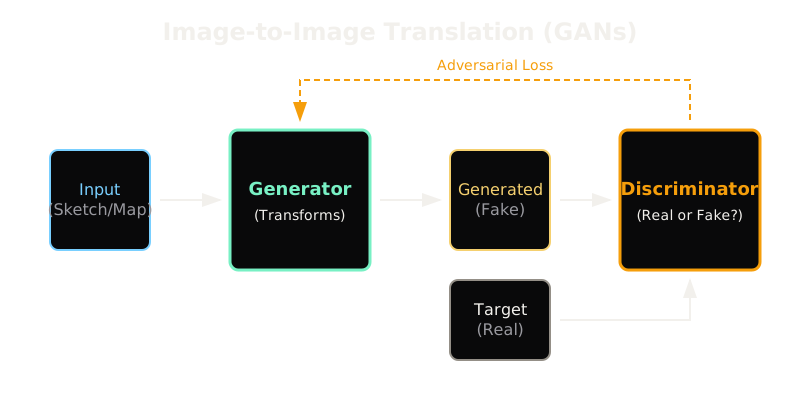
Image-to-image translation typically uses a conditional GAN: both networks see the input image , so every judgment is about the pair, not the output alone.
The generator is usually an encoder-decoder with skip connections (a U-Net). The encoder compresses the input sketch into high-level features, the decoder expands back to the target photo , and skip connections carry edges and boundaries past the bottleneck so they survive compression. The discriminator is usually a PatchGAN: it takes the concatenated pair or and outputs a grid of real-or-fake scores over local patches instead of one global verdict, forcing crisp high-frequency detail everywhere.
Training combines two pressures. The adversarial loss pushes to look like a real member of the target domain, while an penalty (mean absolute error against the ground truth ) forces structural faithfulness so the generator cannot ignore the input. Pix2pix weights the term by , heavily favoring faithfulness; turning down buys realism at the price of hallucinated content.
Worked example
Take one target pixel with the generator's current output . The error on that pixel is , and with it contributes to the generator objective before averaging. Meanwhile the PatchGAN scores four patches of the pair as : three patches read as real, one (the ) exposes a blurry region. The mean score is . The two numbers pull in complementary directions: the demands the pixel move toward , the patch score demands sharper texture exactly where the blur sits.
Code
The point of this snippet is the worked example's arithmetic in plain Python: the weighted term and the mean PatchGAN score over four patches.
# -> Weighted L1 plus mean patch score for the worked example.y, y_pred, lam = 0.8, 0.5, 100l1 = abs(y - y_pred)print(round(l1, 4), round(lam * l1, 4))# -> (0.3, 30.0)
patches = [0.9, 0.2, 0.7, 0.6]print(round(sum(patches) / len(patches), 4))# -> (0.6)A pixel error of becomes under , and the four patch scores average to . Real training backpropagates through both terms jointly instead of printing them.
Watch Out For
Mode collapse in unpaired translation
In unpaired setups such as CycleGAN, where no exact pairs exist, the generator can map many inputs to one output that fools the discriminator. The symptom is suspiciously uniform translations across diverse inputs. Cycle consistency (translating A to B and back must return the original) mitigates it, but severe distribution mismatches still defeat it: check output diversity, not just realism.
Ignoring the input condition
If the adversarial loss outweighs the term, the generator emits stunning images that abandon the sketch. The symptom is high realism with drifting edges and invented content. Fix: raise back toward , verify edge alignment on held-out pairs, and only then tune realism.
The Quick Version
- Image-to-image GANs translate an image across domains, such as sketch to photo, while keeping its structure.
- Both networks condition on the input: the generator maps to , and the discriminator scores the pair.
- The generator is typically a U-Net whose skip connections preserve edges through the bottleneck.
- The discriminator is typically a PatchGAN scoring local patches, which forces crisp detail everywhere.
- The worked pixel with and pays of , weighted to , while four patches average .