Pix2Pix
Pix2Pix learns translation from perfectly paired examples, turning sketches into photos by combining adversarial sharpness with pixel-wise faithfulness.
Why Does This Exist?
Unconditional and class-conditional GANs invent freely, but editing tasks need obedience: this exact sketch, rendered as a photo, with every wall where the lines say. Pure pixel regression (L1 alone) obeys but produces blur, averaging all plausible photos into grey mush. Pure adversarial training sharpens but hallucinates, moving windows and doors.
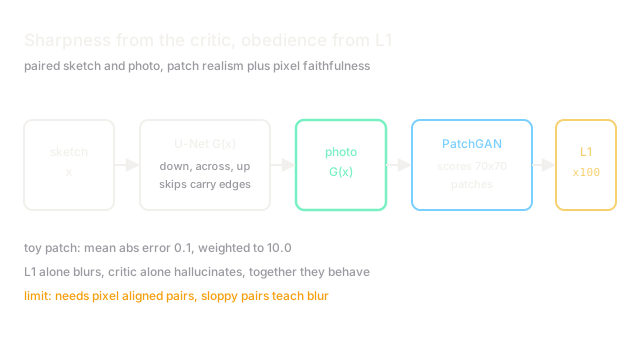
Pix2Pix runs both losses at once on paired data. The PatchGAN critic demands local realism patch by patch, while a heavy L1 term chains the output to the ground-truth photo. The umbrella page for this family is image to image GANs, the conditioning idea underneath is the conditional GAN, and the unpaired-data sibling is CycleGAN.
Think of It Like This
A sign painter with a strict customer
A customer hands a sign painter a pencil sketch and stands behind them. The painter wants flair, bold colours, dramatic shading. The customer wants the sketch honoured, every letter where drawn. Left alone the painter improvises; micromanaged with a ruler the sign turns lifeless.
The critic is the painter's pride, demanding every patch look professionally painted. The L1 term is the customer with the ruler, checking each stroke against the sketch. Good signs need both, and the arrangement collapses when either leaves the shop.
How It Actually Works
The generator is a U-Net: an encoder down to a bottleneck and back up, with skip connections shuttling fine spatial detail straight across. The discriminator is a PatchGAN that scores overlapping patches as real or fake and averages, which concentrates capacity on local texture where blur shows most:
is the input sketch, the paired target photo. The L1 term uses absolute error rather than squared so edges stay crisp instead of averaged. Dropout, not noise vectors, provides output variation at test time.
Worked example
A target patch and output . Absolute errors are on all four cells, mean , weighted by to of loss. Meanwhile the PatchGAN scores each -pixel neighbourhood for realism; a blurry-but-close output minimises L1 yet loses the adversarial game, which is exactly why the combination beats either loss alone.
Code
Combined Pix2Pix objective on one batch, showing the heavy L1 weight.
import math
def pix2pix_loss(d_real: list[float], d_fake: list[float], gen: list[list[float]], target: list[list[float]], lam: float = 100.0) -> float: """Adversarial terms plus weighted L1 faithfulness.""" adv = -sum(math.log(v) for v in d_real) / len(d_real) - sum(math.log(1 - v) for v in d_fake) / len(d_fake) flat = [(a - b) for gr, tr in zip(gen, target) for a, b in zip(gr, tr)] l1 = sum(abs(v) for v in flat) / len(flat) return adv + lam * l1
gen = [[0.7, 0.3], [0.5, 0.5]]tgt = [[0.8, 0.2], [0.4, 0.6]]print(round(pix2pix_loss([0.9], [0.4], gen, tgt), 2)) # -> 10.62Watch Out For
Training on sloppy pairs
Pix2Pix trusts alignment completely. If sketches and photos shift by even a few pixels, the L1 term punishes correct sharp edges for sitting on the wrong pixel, and the generator learns defensive blur to split the difference.
Verify alignment before training: overlay pairs and check edges coincide. If pairs cannot be aligned, switch to the unpaired approach rather than forcing Pix2Pix.
Dropout turned off at test time kills diversity
Standard inference disables dropout, which makes the generator fully deterministic: one sketch, one photo, always. Users expecting variations conclude the model is broken.
Keep dropout active for diverse samples, or accept determinism as designed. Document which mode the demo uses.
The Quick Version
- Pix2Pix translates paired images with a U-Net generator and a PatchGAN critic.
- Adversarial loss supplies sharpness, L1 with weight supplies faithfulness.
- Our toy patch gives L1 , contributing to the total loss.
- Skip connections carry fine detail past the bottleneck; dropout supplies variation.
- Misaligned pairs teach blur, and test-time dropout controls output diversity.