DINO Denoises Queries for Detection
Detection DINO trains with noised boxes as extra queries, so matching stabilizes and small boxes converge fast.
Why Does This Exist?
DETR matching flips early: same query grabs different objects across epochs, slowing training. Deformable helps cost but not assignment noise.
DINO adds denoising supervision. It extends detr matching, uses deformable sampling, and grounds grounding dino later work. Self-supervised DINO is a different method in dinov2.
Think of It Like This
Tracing over faint outlines before freehand
You trace wobbly copies of a drawing before drawing freehand. Tracing teaches hand stability, so freehand lines land closer.
Noised boxes are tracing sheets, learnable queries are freehand. Where it stops: tracing only helps if noise mimics real errors, just as denoising needs tuned noise scales.
How It Actually Works
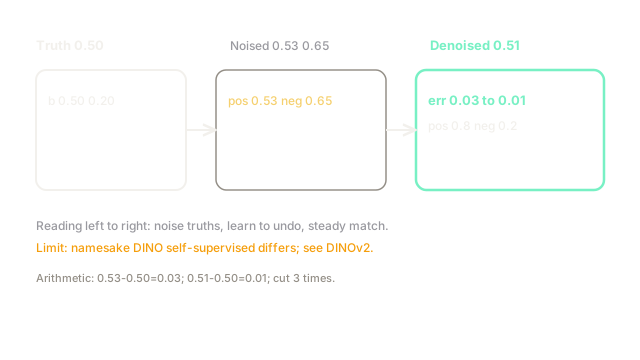
Take truth box . Make positive noised jitter and negative shift. Feed both as extra decoder queries with labels to reconstruct or reject. Main queries use mixed selection: top encoder spots init positions while content stays learned.
Worked example
Truth . Positive must map back: error . Model outputs , residual , so denoising cuts error three times. Negative at must predict background with score below versus positive above . The extra loss steadies bipartite pairs within 12 epochs.
Watch Out For
Confusing detection DINO with self-supervised DINO
Same letters name Caron self-distillation and Zhang detection denoising. Symptom: citing wrong paper or mixing losses. Fix: this page is Zhang 2022 detection; for Caron 2021 features see DINOv2.
The Quick Version
- Detection DINO is denoising DETR, not self-supervised DINO.
- Noised positives rebuild truth while far negatives reject.
- Fixture error drops 0.03 to 0.01 with denoising help.
- Mixed selection inits positions from top encoder spots.
- See DINOv2 for self-supervised namesake.