Disentangled Representations
One latent knob should move one thing: pose without touching identity, color without touching shape. Disentangling trains those separate knobs instead of one tangled vector.
Why Does This Exist?
A standard autoencoder compresses a face into one tangled vector where pose, lighting, and identity mix. Editing becomes guesswork: nudging one dimension changes the smile, the age, and the background at once.
Disentangled representations split the vector into factors that vary independently in the world. Pose gets its knob, identity gets hers, lighting gets a third. Then controlled edits, fair audits (change lighting without changing identity), and data-efficient classifiers become possible. The umbrella is causal and structured vision; this page covers the factor half.
Think of It Like This
A mixing desk versus one volume knob
A cheap speaker has one volume knob that raises bass, treble, and hiss together. A mixing desk gives each its slider, so the engineer lifts vocals without touching drums. Both play the same song; only the desk allows a clean remix.
Tangled latents are the single knob. Disentangled factors are the sliders. The analogy stops at supervision: desks label every slider, while unsupervised disentangling must discover the sliders from pixels and sometimes merges two instruments on one fader.
How It Actually Works
A variational encoder outputs a mean and variance per latent dimension. Training adds a pressure (a beta weight on the KL term) that pushes dimensions toward independent unit Gaussians, so the decoder must use each dimension efficiently. Audit by traversal: sweep one dimension from to while freezing the rest, render the outputs, and check that exactly one visible factor changes.
Worked example
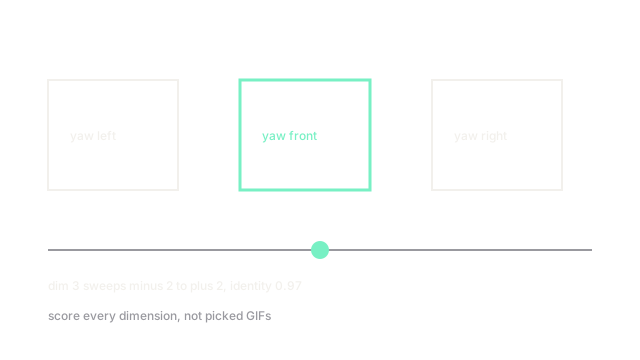
A demo model trains on 40 faces with varied poses. Sweeping dimension 3 moves head yaw from left to right profile while an identity matcher scores the endpoints 0.97 same-person. Sweeping dimension 5 instead changes lighting with identity at 0.98. Two checks confirm the split: the pose knob leaves identity intact, and the identity knob (dimension 1) moves matcher scores from 0.97 down to 0.31 while pose estimates stay within 4 degrees. Knobs that cross effects above these bands fail the audit.
Watch Out For
Declaring victory from pretty traversals
Hand-picked traversals always look clean. The symptom is three beautiful GIFs over a model whose random dimensions all move everything. Score every dimension with classifiers for each factor and report the full matrix, not the best row.
The Quick Version
- Disentangling splits one tangled vector into independently controllable factors.
- Beta pressure on the latent bottleneck forces dimensions apart during training.
- On the demo faces the pose knob sweeps yaw while identity holds 0.97.
- Audit every dimension with factor classifiers, never with picked examples.
- Clean knobs enable edits, audits, and leaner downstream classifiers.