Efficient Large-Scale Pretraining
Pretraining eats GPU-years most labs never see. Efficient methods — masking, filtering, staging — buy the same eyes for a fraction of the compute.
Why Does This Exist?
Frontier pretraining bills read like phone numbers: thousands of GPU-years per run, affordable to a handful of labs, repeatable by none of the rest. Research Stratifies into those who train eyes and those who rent them — and rented eyes cannot be opened, fixed, or fully trusted. Carbon and iteration speed argue alongside equity.
Efficient pretraining buys eyes cheaply: mask most tokens (encode the visible few), filter dead-weight images before training, stage resolutions from coarse to fine. Each multiplies the others, and careful combinations reach competitive backbones on academic budgets. The quality-over-quantity ally is data-centric AI; the consumer is video foundation models.
The one idea you need first. Masked image modeling hides of patches and reconstructs them from the visible quarter: the encoder runs on of tokens, attention work falls roughly sixteenfold, and the puzzle stays hard because images are redundant. Data filtering keeps the top fraction by learned quality scores (aesthetic, text-alignment, dedup), discarding watermarks and duplicates before they bill GPU-hours.
Think of It Like This
Skimming solved problems, not copying textbooks
Two students face the same textbook. One copies every page longhand (full training on raw data); the other skims solved examples, drills the hard exercises, and skips the misprints (masking plus filtering). Exam day favors the skimmer — same syllabus, quarter of the hours, sharper on what matters.
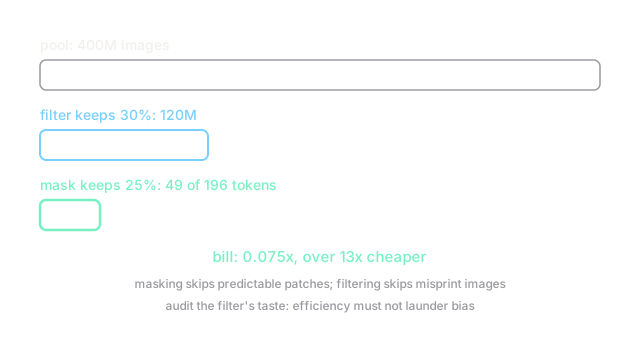
Efficient pretraining is disciplined skimming. Masking skips the predictable patches; filtering skips the misprint images; staging reads the easy chapters first. Copyists object that skimmers "see less" — true, and beside the point, because seeing wisely beats seeing everything.
How It Actually Works
Recipes layer three savings. Mask: patch masking with tiny decoders (asymmetric MAE design: big encoder on visible tokens, small decoder for reconstruction). Filter: score pools with cheap models, keep – (CLIP-score, aesthetic, NSFW and dedup screens). Stage: warm up at low resolution, finish short at full — most learning happens coarse. Mixed precision, gradient checkpointing, and sharded optimizers multiply the savings underneath.
Measure wall-clock per quality point (linear-probe accuracy per GPU-hour), not epochs: efficient methods win some epochs by losing others.
Worked example
Pool M images; keep after filtering: M. Tokens per image ; visible after masking: (). Attention work scales roughly with token fraction squared per image times image fraction: of the full-data full-token bill — over cheaper ().
Linear costs (decoding, I/O) scale nearer as well, so the whole run lands roughly an order of magnitude cheaper. That order of magnitude is the difference between a corporate cluster and a university one.
Code
The point of this snippet is the multiplication: filtering times masking sets the budget before a single GPU spins.
def budget_fraction(keep_images: float, keep_tokens: float) -> float: return keep_images * keep_tokens # independent savings multiply
print(round(budget_fraction(0.3, 0.25), 4)) # -> 0.075print(round(1 / 0.075, 1)) # -> 13.3Watch Out For
Filters that bake in their own blindness
Quality scorers have tastes: aesthetic models downvote dark-skinned faces and night scenes, text-alignment filters drop non-English content, dedup erases rare cases as "duplicates". Filtering to with a biased scorer manufactures a biased dataset wearing efficiency's halo.
Audit kept-versus-dropped slices for demographic and content skew before training. Efficiency that homogenizes the data charges interest at deployment — paid by whoever the filter disliked.
Masking ratios tuned for someone else's modality
Vision's sweet spot assumes image redundancy; video (more redundant) wants , text (less) wants . Copying ratios across modalities under-trains dense signals and overprices sparse ones.
Sweep masking per modality and report the curve, not just the winner. The ratio is a property of the data's redundancy, never a universal constant.
The Quick Version
- Efficient pretraining multiplies three savings: masking, filtering, and staged resolutions.
- The worked fixture keeps of images and of tokens: of the bill, cheaper.
- Measure accuracy per GPU-hour on target hardware, not epochs or FLOPs in a vacuum.
- Audit filters for skew: efficiency must not launder bias into the dataset.
- Sweep masking per modality; redundancy sets the ratio, not convention.