Fine-Grained Image Classification
Fine-grained classification tells apart near-identical categories, like bird species or car models, where a beak curve or headlight shape matters more than the whole scene.
Why Does This Exist?
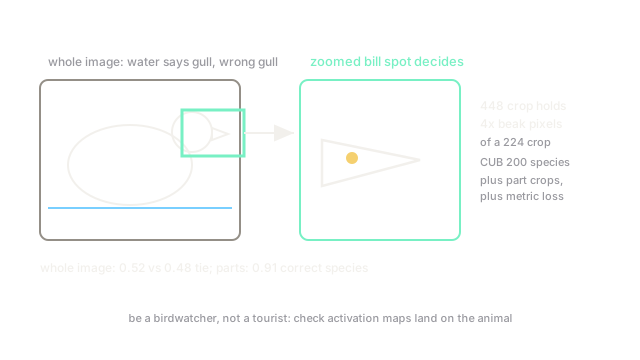
Telling a dog from a car is easy. Telling a herring gull from a ring-billed gull is the actual job in wildlife monitoring, retail and manufacturing, and plain image classification trained naively learns the background instead: water means gull, road means car. Fine-grained classification exists for categories with tiny inter-class gaps and large intra-class variation, where the signal hides in parts, not scenes.
Think of It Like This
A birdwatcher, not a tourist
A tourist sees a white bird over water and says gull. A birdwatcher checks the bill markings, the wingtip pattern and the leg color, three small patches that separate a dozen lookalike species.
Fine-grained models are trained to be birdwatchers. Architectures and losses push attention onto those small patches, because the global silhouette is shared across the whole confusing set.
How It Actually Works
What makes it hard
Two properties define the task. Inter-class differences are tiny: species differ by a bill spot. Intra-class variation is large: the same species appears juvenile or adult, flying or perched, in sun or fog. Standard cross-entropy on whole images latches onto background correlations, so the fix is forcing the network onto parts.
The standard tricks
Part attention. Networks learn to localize discriminative patches, heads, wings, headlights, then classify from the zoomed crops. Accuracy on benchmarks like CUB-200 climbs several points over whole-image baselines purely from this zooming.
Metric-flavored losses. Contrastive or triplet-style terms pull same-species embeddings together while pushing lookalikes apart, sharpening boundaries that cross-entropy leaves soft. High-resolution inputs help directly: a 448-pixel crop carries four times the beak pixels of a 224-pixel one.
Code
import torchfrom torchvision import models, transforms
model = models.resnet50(weights=models.ResNet50_Weights.IMAGENET1K_V2)model.fc = torch.nn.Linear(model.fc.in_features, 200) # CUB-200 species
fine_preprocess = transforms.Compose([ transforms.Resize(512), transforms.CenterCrop(448), # keep beak-level detail transforms.ToTensor(), transforms.Normalize(mean=[0.485, 0.456, 0.406], std=[0.229, 0.224, 0.225]),])Watch Out For
Background shortcuts masquerade as accuracy
A model scoring 90% on gulls may be reading water versus land. The symptom is collapse on birds photographed in unusual places. Test on backgrounds shuffled across classes, and check activation maps land on the animal before trusting the number.
Label noise hurts more here than anywhere
When classes differ by a bill spot, even expert annotators disagree, and a few percent of wrong labels cap the whole project. The symptom is a validation plateau no architecture fixes. Budget for label review and report inter-annotator agreement alongside accuracy.
The Quick Version
- Fine-grained classification separates near-identical categories by small part-level cues.
- Whole-image training learns backgrounds, so models must attend to discriminative parts.
- High resolution, part crops and metric-style losses each add real accuracy.
- Label noise and background shortcuts are the two failures to check first.