Gait Recognition
Gait recognition identifies people by how they walk, using stride rhythm and limb swing that survive when faces stay hidden or blurred.
Why Does This Exist?
Faces hide behind masks, blur with distance, and raise consent issues. Coats change and fool clothing models. Walking style persists across days and stays visible from afar. Security and health teams need a signal that works when faces do not.
Gait recognition exists for that signal. Input is a walking sequence with silhouettes or joints. Output is an identity embedding compared by distance. Action context is action recognition; the track source is multi-object tracking. Cross camera appearance matching is re-identification.
Use it at distance or when faces are unusable. Use face or clothing models when close views and consent allow stronger cues.
Think of It Like This
Recognizing a friend by footsteps upstairs
You know a housemate by stair creaks and stride rhythm without seeing them. A sprained ankle changes the pattern at once, and carpet versus tile shifts the sound while the rhythm stays.
Silhouettes are the creak pattern. Cycle averaging is listening over several steps. The analogy stops at load: a heavy bag changes a walk more than carpet changes sound, so covariates need explicit handling.
How It Actually Works
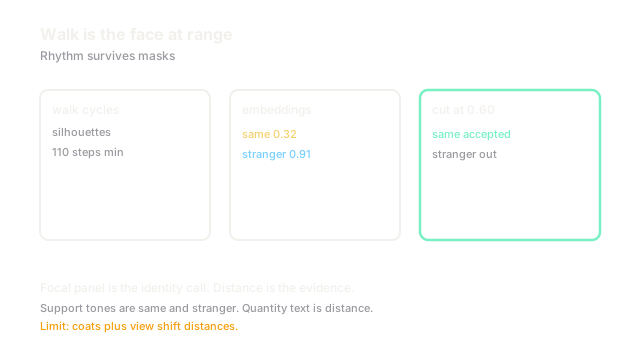
Segment silhouettes or joints per frame, align cycles by heel strike, then average into a gait energy image or sequence embedding. Contract is walk clip in, embedding out. Compare by Euclidean distance . Same person walks score in the fixture while a stranger scores . A cut at accepts the match and rejects the stranger. Cadence near steps per minute plus stride length separate brisk from shuffled walks before identity math.
Worked example
Probe walk A and gallery walk A from one person give embeddings units apart in scaled space at . Stranger walk B gives to A. Threshold calls A same and B different. A bag carry variant of A drifts to , still inside, while a coat plus injury variant drifts to and misses, which shows where covariates bite.
Watch Out For
Clothing and load mistaken for identity
A long coat merges legs in silhouettes and a laptop bag shortens arm swing. The symptom is same person distances jumping from to across days. Fix it with joint based models plus coat and bag augmentation, and report accuracy per covariate.
View change sold as solved
Side views show stride fully while front views compress it. The symptom is cross view matches failing while same view shines. Fix it with view mapping or 3D joints, and test across the exact angles you will deploy.
The Quick Version
- Gait identifies by stride rhythm and limb swing from afar.
- Contract is walk clip in, embedding out, compared by distance .
- The fixture matches at against for a stranger at a cut.
- Cycle averaging steadies the signature across steps.
- Coats, bags, injury, and view shift distances more than identity does.