Person Re-Identification Search
Re-identification finds the same person across cameras that never overlap, matching clothes and shape since faces are usually too small to help.
Why Does This Exist?
One camera sees a shopper enter; another, three aisles away, sees someone leave. Faces are blobs at that resolution and cameras never share a frame. Security and retail analytics still need the answer: same person or not. Re-identification (ReID) exists for this cross-camera matching, learning clothing, shape and gait signatures that survive viewpoint and lighting jumps. It powers DeepSORT association and multi-camera tracking.
Think of It Like This
Spotting a friend in away-game colors
You lose your friend in a stadium crowd and scan the far stand for their walk, jacket blocks and height rather than their face, which is far too small. A changed scarf fools you; a distinctive backpack saves you. ReID networks scan galleries the same way, ranking crops by learned appearance signatures. The analogy stops at the failure it hides: when everyone wears black winter coats, you fail exactly where ReID fails, and only gait or context rescues either of you.
How It Actually Works
Backbones embed each pedestrian crop, often with part branches for head, torso and legs so occlusion of one part leaves the others votable. Triplet loss with hard mining plus a classification head trains the space. At query time the probe embedding ranks the gallery by distance; CMC curves report rank-1 hit rate while mean average precision rewards placing every true match early.
A worked ranking
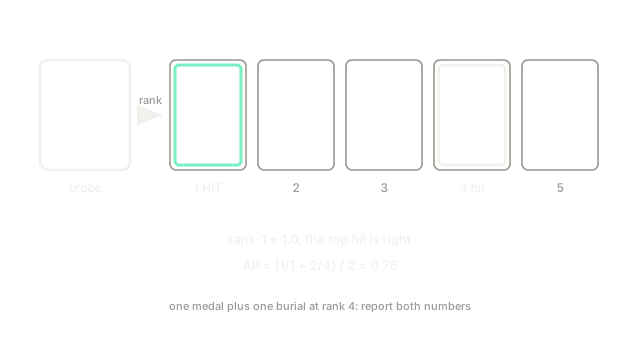
A probe returns five gallery crops with two true matches at ranks 1 and 4. Rank-1 accuracy scores 1.0 since the top hit is correct. Average precision averages 1/1 for the first hit and 2/4 for the second, giving (1.0 + 0.5) / 2 = 0.75. One number praises the top hit; the other punishes burying the second match at rank 4.
Watch Out For
Clothes-change blindness in long deployments
Short-term benchmarks assume one outfit per identity, so models lean on shirt color and collapse when people change clothes. The symptom is rank-1 accuracy halving across days. Fix it by training on clothes-change datasets and weighting face, gait and body-shape cues that survive a wardrobe swap.
The Quick Version
- ReID matches pedestrians across cameras without overlapping views.
- Part-based embeddings keep working under partial occlusion.
- Triplet plus classification losses train the ranking space.
- Rank-1 accuracy and mean average precision measure different ranking virtues.
- Outfit changes defeat clothes-biased models; test across days, not minutes.