HF Transformers Vision Guide
One hub call that loads image-ready transformers with processor and weights matched, so classification and detection start together.
Why Does This Exist?
Vision transformers need three matched pieces: weights, processor config, and tokenizer or label map. Downloading them separately invites silent mismatch. The Transformers library plus hub fixes the bundle: one name resolves all three, the processor resizes and normalizes exactly as training did, and pipelines for classification and detection share the pattern. Pretrained models become one pinned call.
This page covers the bundle contract, one patch-count fixture, and appropriate use.
Think of It Like This
A library with the reading glasses attached
Each book ships chained to the exact glasses its print needs. You check out the pair, read at the right size, and return both together.
Hub models are the books, processors are the glasses. The chain is the model revision. The analogy stops at eyesight: wrong glasses blur one reader, while a wrong processor shifts every score in the batch.
How It Actually Works
Input is a model id plus an optional revision pin and a task pipeline. Output is predictions with the processor's size, normalization and label map applied. Purpose is reproducible transformer inference and fine-tuning across ViT, DETR-style detectors and vision-language models. Appropriate use is standard natural-image tasks with hub weights. Pin the revision in production, because moving hub pointers change weights under a fixed name.
Patch fixture
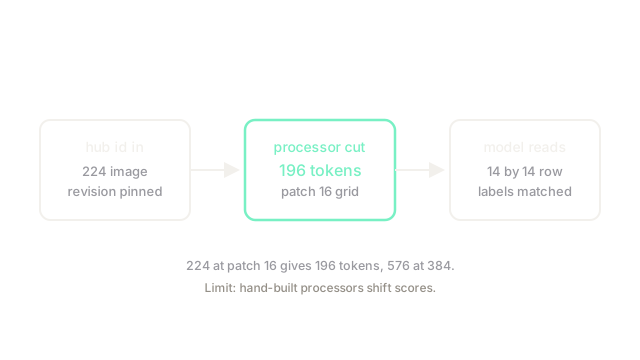
Take a image with patch size . Patches per side are . Total tokens are . Attention cost grows with the square of that count, which is why 384-pixel variants cost far more than their accuracy gain suggests.
Code
Patch counting in plain Python:
def patch_tokens(size: int, patch: int) -> int: per_side = size // patch # patches along one edge return per_side * per_side # grid total
print(patch_tokens(224, 16)) # -> 196print(patch_tokens(384, 16)) # -> 576196 tokens at 224, jumping to 576 at 384.
Watch Out For
Loading the model without its processor
Hand-resizing with guessed normalization runs without error and scores a few points low. The symptom is a leaderboard gap that survives every hyperparameter. Fix it by constructing the processor from the same id and revision as the weights, in the same call block.
The Quick Version
- HF Transformers resolves weights, processor and labels from one hub id.
- A 224 image at patch 16 becomes 196 tokens, 576 at 384.
- Attention cost follows token count squared, so size up deliberately.
- Use it for standard transformer vision tasks with pinned revisions.
- Never pair weights with a hand-built processor.