Low-Pass Filter Image Blurring
A low-pass filter keeps slow brightness swells and drops rapid flicker. Images come back softer, with noise and fine detail gone together.
Why Does This Exist?
Noise lives mostly in high frequencies while scenes live mostly in low ones, so cutting the spectrum's rim removes more grain than content. That is the whole bet of frequency-domain smoothing. It also previews downsampling: whatever survives a low-pass is what a smaller image can faithfully keep.
It is the smoothing operator of frequency-domain processing, built on the Fourier transform. Its mirror is the high-pass filter, and the gentle Gaussian roll-off beats the hard ideal cutoff in practice.
Think of It Like This
A fence that stops sand, not boulders
Pour mixed gravel through a mesh: fine sand falls through and boulders stay. A low-pass fence works in reverse, keeping the boulders (broad shapes) and dropping the sand (fine grain) out of the picture. Mesh size is the cutoff frequency. A torn mesh edge with a gradual weave, the Gaussian roll-off, sorts without kicking up dust clouds, which are the ringing ripples a sharp cutoff leaves behind.
How It Actually Works
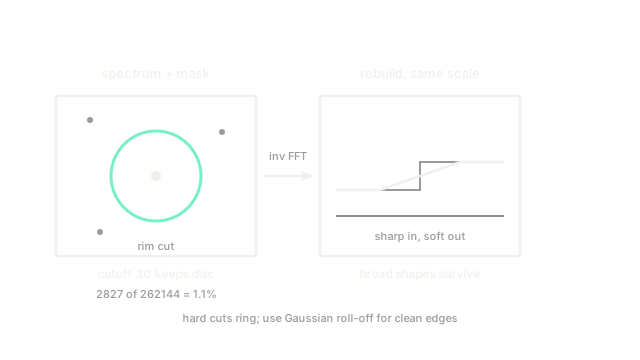
Transform the image with the FFT, multiply the centered spectrum by a mask that is 1 near the middle and 0 toward the rim, then inverse-transform. The ideal mask cuts hard at radius : keep everything inside, zero everything outside. Gaussian and Butterworth masks taper smoothly instead, trading a softer blur for freedom from ringing. Lower cutoffs blur harder; the cutoff radius is the single dial.
Worked example
Take a image, so the spectrum holds coefficients, and apply an ideal cutoff at radius 30. The kept disc covers about coefficients, barely of the total, yet the reconstruction still shows every broad shape because scenes concentrate energy centrally. That carrying the whole composition is why low-pass previews stay readable.
Watch Out For
Ringing from hard cutoffs
Ideal masks chop the spectrum with a cliff, and the reconstruction ripples around every edge like pond waves. The symptom is concentric echoes outlining high-contrast boundaries. Swap the ideal disc for a Gaussian or Butterworth roll-off whenever edges must stay clean.
The Quick Version
- Low-pass masks keep central slow frequencies and zero the rim.
- Grain and fine texture leave with the highs; broad shapes stay.
- Cutoff radius is the blur dial: smaller means softer.
- Hard ideal cutoffs ring around edges; smooth roll-offs do not.
- Whatever survives predicts what downsampling can keep.