High-Pass Filter Edge Extraction
A high-pass filter drops slow shading and keeps rapid change. Edges and texture pop out against darkness.
Why Does This Exist?
Sometimes the shading is the nuisance: uneven lighting, slow gradients, blank backgrounds drowning the defects you hunt. A high-pass filter deletes that slow content and leaves edges, texture, and specks standing on near-black. Add the result back onto the original and you have frequency-domain sharpening.
It is the detailing operator of frequency-domain processing via the Fourier transform. It complements the low-pass filter, and its spatial cousin is sharpening by unsharp masking.
Think of It Like This
Reading footprints after snowfall
Fresh snow buries old hollows and only yesterday's footprints stay crisp. A high-pass filter is that snowfall rule in reverse: it buries the slow drifts (shading) and keeps the sharp prints (edges). But it also keeps the rabbit pellets, which is noise riding along with detail. Snow clarifies and litters at once, so you still sweep first.
How It Actually Works
FFT the image, multiply the centered spectrum by a mask that is 0 near the middle and 1 toward the rim, then inverse-transform. Ideal, Gaussian, and Butterworth variants mirror the low-pass family with the pass region flipped. The result shows rapid changes on a dark field: edges glow, texture reads, backgrounds vanish. Mixing a scaled copy back with the original sharpens globally, exactly like unsharp masking with the blur done in frequency space.
Worked example
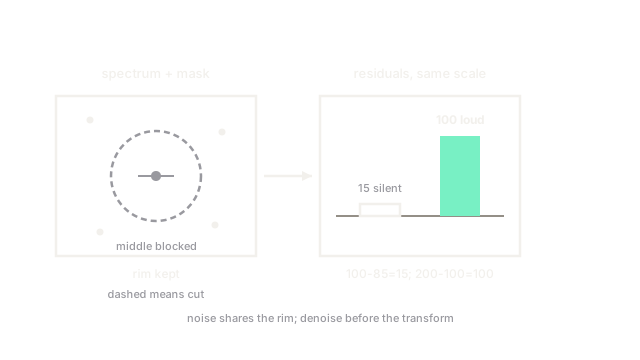
A flat pixel reads 100 with its local low-pass at 85, so the high-pass residual is : nearly silent. An edge pixel reads 200 against a local low of 100, giving : loud. Same operation, 15 versus 100, which is how one mask separates background from boundary without any threshold.
Watch Out For
Noise arrives amplified
High-pass keeps grain alongside edges because both live in the rim, so noisy inputs return texture maps full of static. The symptom is speckle competing with real boundaries at equal brightness. Denoise before the transform, and raise the cutoff to dump the noisiest outermost rim when detail allows.
The Quick Version
- High-pass masks zero central slow frequencies and keep the rim.
- Slow shading and backgrounds vanish; edges and texture remain.
- Adding the residual back onto the original sharpens the image.
- Noise shares the rim with detail, so denoise first.
- Cutoff radius trades edge completeness against noise pickup.