Neuromorphic Vision
Brains run vision on milliwatts by spiking only when needed. Neuromorphic vision copies the trick: event sensors plus spiking chips that compute with spikes, not frames.
Why Does This Exist?
Always-on vision is a power hog. A security camera plus GPU burns tens of watts around the clock to report that nothing happened — again. Batteries, drones, and sensor dust cannot afford it, and the grid cost of scaling frame-based perception to every lamppost is its own argument. Biology's answer (a brain on watts, a retina on milliwatts) proves sparse, event-driven perception suffices.
Neuromorphic vision co-designs sensor and processor around spikes: event cameras emit change events, spiking networks compute on them directly, and power follows activity instead of the clock. The sensor half is event cameras; the compute half is spiking networks; the map is alternative sensing.
The one idea you need first. Activity-proportional power means idle circuits cost near zero: no events, no switching, no watts. Frame pipelines pay full price per frame regardless of content (the GPU cannot tell a still hallway from a chase). The crossover is workload-shaped — busy scenes narrow the gap, quiet ones explode it — which decides where neuromorphic hardware wins.
Think of It Like This
A string quartet versus a stadium PA
A stadium PA blasts at full power all evening so the back rows hear announcements — mostly silence, at full volume. A string quartet plays only its notes: pianissimo passages sip bow rosin, fortissimos spend it. Same audience reached, wildly different energy, because cost follows the music instead of the clock.
Neuromorphic chips are the quartet: spikes are bow strokes, silence is free. Frame pipelines are the PA: every frame a full-volume announcement whether anything happened. For doorbells and drones (long silences, brief action) the quartet wins by orders of magnitude; for cinemas (every seat, every second) the PA's constant roar is the honest price.
How It Actually Works
Events stream from the sensor into spiking cores where neuron voltages integrate arrivals and fire onward — no frame buffers, no clock-gated ALUs churning zeros. On-chip learning or mapping tools place trained SNNs; interfacing layers translate spikes to decisions (counts, first-spike times, population votes). Power accounting splits into static leakage (small, always) plus dynamic cost per spike event (the bill that scales with scene motion).
Benchmarks measure accuracy per joule on event datasets (gestures, driving, tracking) against frame baselines at matched accuracy — the fair fight, since raw accuracy still favors frames on static tests.
Worked example
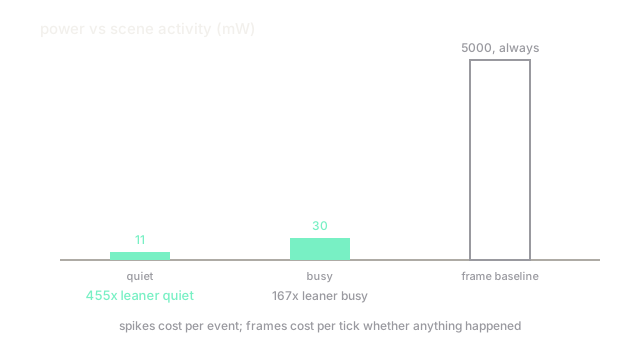
Budget sketch under stated assumptions: static leakage mW plus mW per events per second.
- Quiet hallway, events/s: mW.
- Busy street, events/s: mW.
- Frame baseline (camera plus GPU share): mW regardless.
Ratios: at quiet, at busy. The advantage compresses with activity but stays hundredfold — power follows the scene, which is the entire architectural bet. Real chips vary; the shape (flat-ish versus flat) is what transfers.
Code
The point of this snippet is the power shape: one line shows cost tracking activity while the baseline never moves.
def neuromorphic_power(events_per_s: float) -> float: return 10.0 + 0.1 * (events_per_s / 1000.0) # mW: leakage plus per-spike
print(round(neuromorphic_power(10000))) # -> 11print(round(neuromorphic_power(200000))) # -> 30print(5000) # -> 5000Watch Out For
Toolchains a decade behind frame stacks
Mapping a trained model to spikes means quantization, reset schemes, and latency tuning with young tools and sparse documentation. Teams budget chip time and forget toolchain months: the model that trains in a day takes a quarter to deploy.
Prototype on SNN simulators first, borrow conversion pipelines where they exist, and staff the deployment — not just the paper. Immature plumbing has sunk more neuromorphic projects than neuron math.
Static benchmarks flatter frames
Accuracy leaderboards built on static photo datasets reward exactly what spikes skip: dense texture analysis of unchanging scenes. A neuromorphic system that wins on joules-per-decision at matched task performance still "loses" the headline accuracy number.
Evaluate on event-native tasks (high speed, high range, always-on duty cycles) with energy in the metric. Judging a quartet by stadium-PA loudness misses the point of the instrument.
The Quick Version
- Neuromorphic vision pairs event sensors with spike processors so power follows activity.
- The worked sketch gives mW quiet and mW busy against a mW frame baseline.
- No events means no switching: silence is free, motion spends where it matters.
- Young toolchains cost quarters, not days — prototype in simulators first.
- Judge on event-native tasks with energy in the metric, not static photo leaderboards.