Event and Alternative Sensing
Normal cameras miss what falls between frames, beyond visible light, or behind glare. Alternative sensors — event, thermal, spectral, depth, polarization — see what RGB cannot.
Why Does This Exist?
RGB frames fail loudly at the edges: fast motion smears, headlights saturate, night blinds, glass hides heat, and depth stays guesswork. Each failure discards light the scene freely offers — microsecond changes, infrared emission, spectral fingerprints, travel time, polarization angle. Standard cameras throw all of it away before the first convolution.
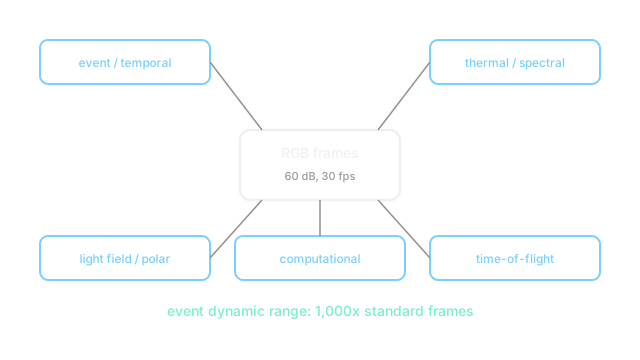
Alternative sensing keeps it. Six families cover the gaps: temporal (event cameras, neuromorphic vision, spiking networks), spectral (thermal, multispectral), angular (light field, polarization), active depth (time-of-flight), and computational (compressive sensing, computational photography). This page maps the territory; each family gets its own.
The one idea you need first. Dynamic range in decibels measures the ratio between the brightest and dimmest recordable signals: . A dB camera spans ratios of ; a dB event sensor spans . The thousandfold gap between them is why headlights blind one sensor and merely register on the other.
Think of It Like This
A band, not a solo piano
A piano plays every note in the score and nothing else: one timbre, one octave span, fixed in place. A band adds bass below the piano's floor, piccolo above its ceiling, and drums that mark time the keys cannot. Same song, more of it audible.
RGB is the piano: three broad bands, fixed exposures, bounded range. Each alternative sensor is another instrument — event pixels the drums (timing), thermal the bass (heat below red), multispectral the strings (narrow tones between piano keys), ToF the metronome (distance as rhythm). Fusion is the arrangement: more instruments, more song, more rehearsal to keep them in tune.
How It Actually Works
The families divide by what they add. Temporal sensors trade frames for change events with microsecond stamps and dB range. Spectral sensors add bands where materials differ (chlorophyll edge, body heat). Angular sensors record ray direction (refocus after capture) or polarization (surface orientation, glare removal). Active depth sensors time their own photons for per-pixel distance. Computational methods trade optics and algorithms: fewer measurements than pixels, smarter reconstruction.
Fusion joins them late (decision-level, robust to missing modalities) or early (feature-level, richer but brittle). Calibration — spatial, temporal, radiometric — decides whether fusion helps or corrupts.
Worked example
Compare dynamic ranges. Standard camera: dB ratio . Event sensor: dB ratio . Relative advantage: .
A tunnel exit at noon spans roughly that thousandfold step from shadow to sunlight. The standard camera exposes for one end and clips the other; the event pixel logs brightness changes across the whole span without ever setting an exposure.
Code
The point of this snippet is the range arithmetic: decibels to ratios, and the thousandfold gap between the families.
def db_to_ratio(db: float) -> float: return 10.0 ** (db / 20.0) # amplitude-ratio convention
rgb = db_to_ratio(60.0)event = db_to_ratio(120.0)print(int(rgb)) # -> 1000print(int(event)) # -> 1000000print(int(event / rgb)) # -> 1000Watch Out For
Every modality taxes something else
Event cameras starve in static scenes, thermal erases identity detail, multispectral needs calibration panels, ToF fails outdoors in sunlight, polarization needs rotating filters or specialized pixels. Adopting a sensor for its superpower inherits its kryptonite — and datasets, labels, and pretrained models for exotic modalities are thin.
Prototype against the failure mode, not the brochure: record your actual night, your actual glare, your static scenes. The modality that survives your worst case beats the one that shines in its demo.
Fusion that corrupts faster than it helps
Misaligned timestamps or sloppy extrinsic calibration turn fusion into cross-contamination: thermal ghosts pasted onto RGB faces, depth edges smeared across object boundaries. Early fusion amplifies every calibration error into every feature.
Calibrate spatially, temporally, and radiometrically before fusing, and keep a late-fusion fallback that survives single-modality dropout. If one sensor dies, the system should degrade, not collapse.
The Quick Version
- Six sensing families cover RGB's gaps: temporal, spectral, angular, active depth, and computational.
- The worked fixture shows event pixels spanning the dynamic range of standard frames.
- Each modality trades something away: static blindness, lost texture, calibration burden, or sunlight failure.
- Prototype on your worst case, not the demo reel, before committing to hardware.
- Calibrate all three ways (space, time, radiometry) or fusion corrupts faster than it helps.