SegFormer Segments Without Positions
SegFormer pairs hierarchical transformer encoders with a light MLP decoder, so dense masks come from Glaobal context plus local overlap.
Why Does This Exist?
ViT segmentation needs position codes that break on new sizes plus heavy decoders. Cityscapes tests inputs where that hurts.
SegFormer drops positions and decoders. It builds on hierarchical transformers, serves semantic segmentation, and contrasts mask2former query decoding.
Think of It Like This
Sketching districts then inking with a thin pen
You sketch four map scales with overlapping pencil strokes, then ink final borders with one thin pen instead of a full paint set.
Overlap merges are pencil, Mix-FFN is local ink, and MLP is the thin pen. Where it stops: thin pens cannot fix wrong sketches, just as light decoders need good encoders.
How It Actually Works
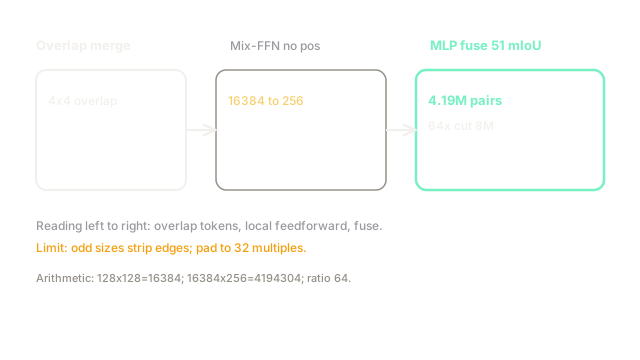
Embed overlap patches, merge per stage. Mix-FFN adds depthwise inside feedforward for locality, no positions. Decoder upsamples four maps to , concats, and applies two MLP layers to masks.
Worked example
gives stage-1 tokens. Reduction cuts keys to . Pairs versus M full, about times cheaper. Four maps upsampled to and fused give mIoU class accuracy in B2 runs at about M encoder weights.
Watch Out For
Testing larger than training without padding care
Overlap merges assume divisible sizes. Symptom: edge strip errors on odd sizes. Fix: pad to multiples of before inference and crop after.
The Quick Version
- SegFormer uses overlap merges plus Mix-FFN with no position codes.
- Light MLP fuses four scales to masks.
- Fixture M pairs replace M, 64 times cheaper.
- B2 reaches about 51 mIoU at 8M weights.
- Pad to 32 multiples for odd test sizes.