Hierarchical Transformers Shrink Maps
Hierarchical transformers halve maps while doubling channels, giving CNN-like pyramids that dense heads reuse directly.
Why Does This Exist?
Single-scale ViT forces detectors to upsample one map. Small and large objects need different resolutions natively.
Hierarchies fix it. They generalize convolutional layers staging, back object detection and semantic segmentation pyramids.
Think of It Like This
Photo prints from contact sheet to poster crop
You keep wallet, print, poster, and billboard crops of one negative. Small faces need the large print, crowds need the small one.
Stages are print sizes, channels are ink depth. Where it stops: too many enlargements blur grain, just as too many merges blur detail.
How It Actually Works
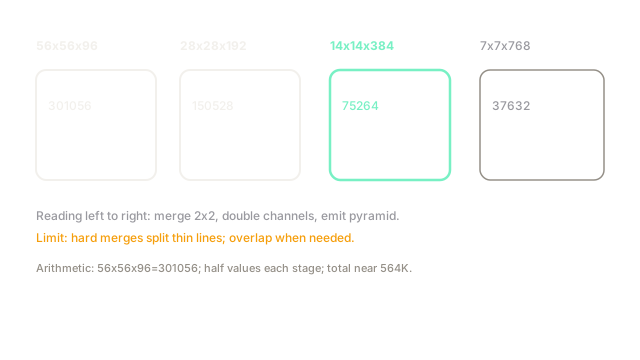
Merge neighbors per stage, halving and doubling . Apply windowed or reduced attention per stage to hold linear cost. Emit four maps for feature pyramids.
Worked example
Start values. Stage 2 is . Stage 3 . Stage 4 . Each halves values while doubling depth, so total stays near K with four usable scales.
Watch Out For
Merging without overlap on thin structures
Non-overlapping merges split one-pixel lines across stages. Symptom: wire or pole gaps in masks. Fix: use overlapping or padded merges when thin structures matter.
The Quick Version
- Hierarchical stages halve resolution while doubling channels per step.
- Four maps at 56, 28, 14, and 7 feed pyramid heads directly.
- Fixture totals stay near 564K values across stages.
- Windowed attention keeps each stage near linear cost.
- Overlap merges when thin lines must survive.