SimSiam Twin Predictor
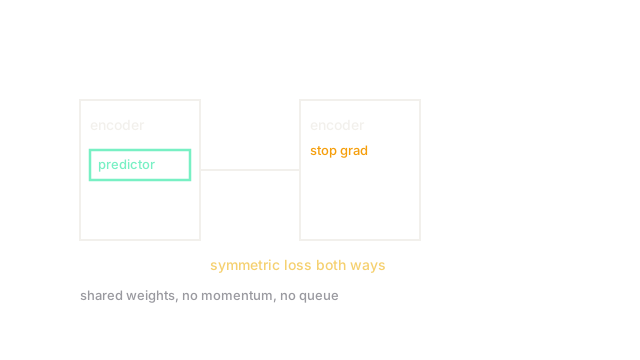
Use one shared encoder on two crops, predict one side from the other, and freeze the second side. That freeze alone stops total collapse.
Why Does This Exist?
BYOL needs a momentum encoder, which adds code and state. SimSiam asks for less: share weights exactly, add a predictor on one side, and stop gradient on the other. With that alone, positives train without queues or slow copies. Readers of siamese networks already know the twin shape; this page adds the freeze that makes it work alone.
This page covers shared twins plus stop-gradient only. Momentum variants are covered by the momentum pages, reachable from contrastive loss.
The one idea you need first.
Symmetric loss runs both directions: predict view from view , then view from view , and average. Sharing weights means one encoder serves both views.
Think of It Like This
Two mirrors with one covered halfway
Two mirrors face each other and one person stands between them. You cover half of the right mirror, then ask the left reflection to guess the hidden half. Because the mirrors are the same glass, the guess trains your eye for faces, not for mirror marks.
Shared weights are the same glass, stop-gradient is the cover, and the predictor is the guess. Where it stops: mirrors reflect at once, while SimSiam alternates which side is frozen.
How It Actually Works
Let and from shared . Predict and with head . Loss is where and takes no gradient. Only and update through .
In plain words: is the small predictor, is negative cosine, and the frozen is the temporary teacher.
Worked example
Take unit and frozen . Norm of is . Cosine is . Term one is . Reverse gives for a slightly worse angle. Loss is , minimized at . A constant output cannot stay at once views vary, so features must track crops.
Watch Out For
Allowing gradient into both sides at once
Removing stop-gradient lets both sides drift together to a constant and loss still falls. Probes then sit at chance. The symptom is fine loss with dead features. Keep the freeze and test with a linear probe on image classification.
The Quick Version
- SimSiam shares one encoder across two views with a small predictor head.
- One side is frozen per term and the loss runs both ways.
- No momentum encoder, queue, or negatives are used.
- Stop-gradient is the part that stops collapse.
- Check probes, not loss, to confirm features live.