Single Object Tracking Basics
Single-object tracking follows one target named in the first frame, learning what it looks like online and re-finding it in every frame after.
Why Does This Exist?
Some jobs name their target up front: follow this car, this player, this cell. Running a full detector every frame and hoping it picks the right one is wasteful and ambiguous. Single-object tracking (SOT) exists for exactly this contract: given the box in frame one, report it in every frame after, learning the target's appearance as it changes. The parent map is object tracking; motion-first classics are in classical object tracking.
Think of It Like This
Trailing one friend through a market
You agree to trail one friend through a crowded market. You memorize their red jacket, predict their pace when they vanish behind a stall, and double-check the jacket (not just the position) when they reappear. If you update your memory with every glimpse, a slow jacket swap can fool you into trailing a stranger: that is template drift. Modern siamese trackers are the same routine in math: compare the remembered patch against each new frame, confirm by appearance, and update the memory with care.
How It Actually Works
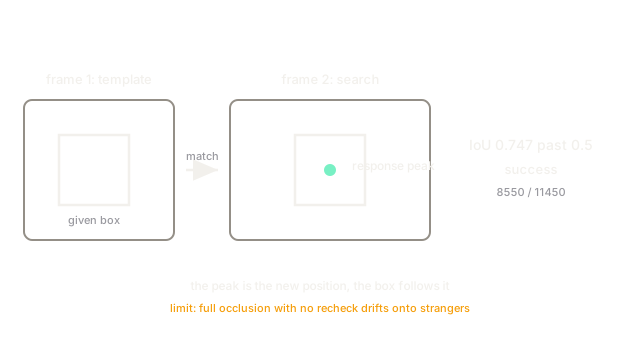
A siamese tracker embeds the initial template and each search region with shared weights, then cross-correlates the two feature maps to produce a response map whose peak is the new position. Region-proposal variants regress a tight box at the peak. The template updates slowly (moving average or learned updater) to absorb lighting and pose change without swallowing the background.
A worked success check
Ground truth covers (50, 50, 100, 100) and the tracker predicts (60, 55, 100, 100) as (x, y, width, height). Intersection spans 90 px in x and 95 px in y, which is 8550 square px. Union is 10000 + 10000 - 8550 = 11450, so IoU is 0.747. The standard 0.5 threshold calls this frame a success, and the success rate over a sequence is the tracker's headline score.
Watch Out For
Template updates that learn the background
Updating the template from every prediction bakes mistakes in: one occluded frame teaches the tracker the occluder. The symptom is slow drift onto nearby textures that never recovers. Fix it by updating only on high-confidence frames and freezing the original template as an anchor.
The Quick Version
- SOT tracks exactly one target initialized by a first-frame box.
- Siamese networks compare a learned template against each new frame by cross-correlation.
- Template updates absorb appearance change but risk drift onto occluders.
- IoU against ground truth, thresholded per frame, is the basic success metric.
- Long occlusions and similar-looking distractors are the characteristic failures.