Smoothing Filters in Images
Smoothing hushes pixel noise by blending each pixel with its neighbours. Pick a plain averager for speed, or an edge-aware one when boundaries must survive.
Why Does This Exist?
Real sensors sputter. A photo taken in low light carries grain, a scan carries specks, and every downstream step suffers: edge detectors treat each speck as a boundary worth reporting. Smoothing first quiets that grain so later stages react to structure instead of static.
The catch is that blur cannot tell noise from detail. A plain averager softens both, which is why the family splits: linear filters like the box and Gaussian blend blindly and fast, while nonlinear ones like the median and bilateral filters choose what to blend and keep edges standing.
Think of It Like This
Hushing a noisy classroom
A teacher quiets a room by asking each row to whisper its answer and taking the consensus. One shouter gets outvoted, which is the median at work. But if the teacher averages instead, the shouter drags the whole row's answer off, like a box filter smearing a speck. And a good teacher ignores whispers from the rival class across the hall, which is the bilateral filter refusing to blend across an edge. Consensus helps only when you pick whose voices count.
How It Actually Works
Every smoothing filter slides a window over the image and replaces the center pixel with a blend of the window. Linear filters use a fixed weighted sum: the box filter weights every neighbour equally, and the Gaussian filter weights close neighbours most. Nonlinear filters decide per window: the median filter takes the middle value, and the bilateral filter down-weights neighbours that look different.
Worked example
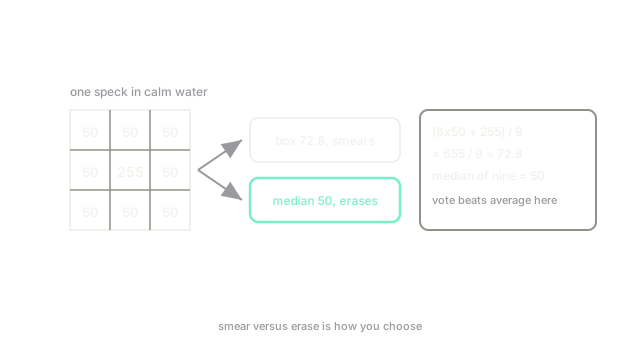
Put one hot speck in a calm neighbourhood: eight pixels at 50 and one at 255. A box mean gives , so the speck smears into every neighbour. The median of is 50, and the speck vanishes completely. That split, smear versus erase, is how you choose between averaging and order-based smoothing.
Watch Out For
Smoothing away the evidence
Every pass of smoothing erases fine detail along with noise: thin lines fade, textures flatten, and small objects shrink. The symptom is a clean image on which nothing small is detectable anymore. Smooth once at the smallest window that kills the noise, and do detection on the lightest smoothing that works.
The Quick Version
- Smoothing blends each pixel with its window to hush noise before later stages.
- Linear filters average blindly and blur edges; nonlinear ones protect structure.
- Box is fastest, Gaussian is the standard pre-filter, median kills impulses, bilateral keeps edges.
- Stronger windows remove more noise and more detail, so size is the main dial.
- Smooth once, lightly, and never twice without a reason.