Sobel Operator Edge Detection
Sobel pairs two small kernels that sense brightness change sideways and vertically. Strong responses mark edges, with direction thrown in.
Why Does This Exist?
Edges are where brightness jumps, and jumps are derivatives. But raw pixel differences amplify every grain of noise into a false edge. Sobel answers with smoothing built in: each kernel differentiates along one axis while averaging along the other, with the center row weighted double for stability.
It is the workhorse gradient estimator behind spatial filtering and the front end of the Canny detector. Its simpler cousin Prewitt skips the double weighting and pays in noise.
Think of It Like This
Feeling a step in the dark
Find a staircase step by sliding one hand sideways while the other steadies you on the rail. The sideways hand feels the drop, the steadying hand averages out your wobble. Sobel's Gx hand reaches left and right for the drop while its 1-2-1 column steadies along the vertical, trusting the middle most. One hand differentiates, the other smooths, and together they feel steps without tripping on carpet bumps.
How It Actually Works
Two kernels estimate the horizontal gradient and vertical gradient . is the image brightness:
subtracts the left column from the right, doubling the center row. subtracts the top row from the bottom. Edge strength is the magnitude and edge direction is . Flat regions return near zero from both.
Worked example
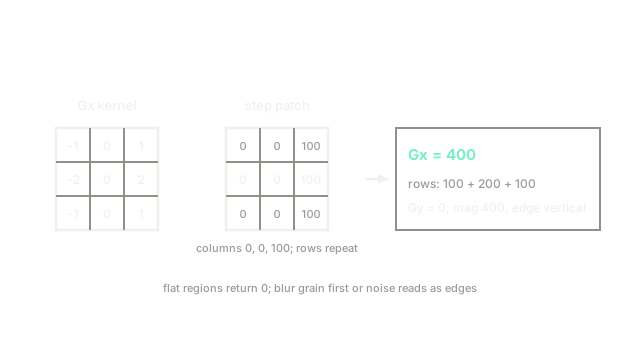
A sharp dark-to-light step fills the window:
. by symmetry, top and bottom rows match. Magnitude is pointing horizontally. A strong signed 400 from a 100-step shows why Sobel rarely misses real boundaries.
Watch Out For
Noise poses as edges
Derivative kernels amplify single-pixel spikes exactly like steps, so grainy images return edge maps full of confetti. The symptom is dense speckle responses in flat skies and walls. Blur lightly with a Gaussian first, and confirm suspicious edges persist across a slightly stronger blur.
Reading signed responses as brightness
and swing negative on light-to-dark steps, and naive casting to bytes clips every negative to zero, erasing half the edges. The symptom is edges visible in only two of four orientations. Take the magnitude, or scale signed output symmetrically, before display.
The Quick Version
- Sobel estimates horizontal and vertical gradients with two 3x3 kernels.
- Center rows count double, baking smoothing into the derivative.
- Magnitude gives edge strength and the arctangent gives direction.
- Always smooth grainy images first or noise reads as edges.
- Handle signed output carefully so light-to-dark steps survive display.