Surveillance and Security
Surveillance vision watches many cameras at once to flag the few moments that need a human, balancing missed events against alarm fatigue.
Why Does This Exist?
No team watches feeds for hours without missing the seconds that matter. Recording everything shifts the pain to review: finding one intrusion in a week of video by scrubbing. False alarms train operators to ignore the monitor wall.
Surveillance vision exists to triage. Input is multi camera streams plus site rules. Output is ranked events with clips for review. Tracking is multi-object tracking; moment labels are action recognition. The video frame is video understanding.
Use it when response time matters and humans must stay in the loop. Use forensic search alone when live response is not required.
Think of It Like This
A night nurse call board
A ward nurse cannot stand in every room. Each room has a call button plus a motion chime, and the board lights only rooms that need a visit with a short note. Too sensitive a chime and the nurse mutes the board.
Streams are rooms, events are call lights, precision tuning is chime sensitivity. The analogy stops at consent: patients summon the nurse while observed people never pressed a button, so retention and notice rules bind surveillance in ways wards never meet.
How It Actually Works
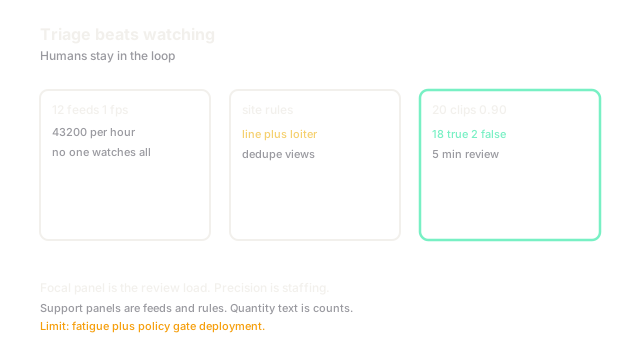
Detect and track per camera, then apply site rules: line cross, loiter over seconds, object left behind. Score and deduplicate across overlapping views by identity and time. Contract is streams plus rules in, events with start, camera, and clip out. A hall with cameras at fps makes images per hour. A filter at precision that fires times per hour asks true reviews and false one. At precision the same true events arrive buried in false ones.
Worked example
A gate line rule fires times in a night with true crossings and shadows. Precision . Operators review clips of seconds, about minutes. Lowering the threshold doubles fires to with true and false. Precision falls to and review doubles to minutes for one extra true event, which the night team feels as fatigue.
Watch Out For
Alert fatigue that trains ignoring
Every extra false alarm teaches a faster dismiss click. The symptom is true events acknowledged in seconds on day one and minutes by week three. Fix it by tuning for precision at the operator budget, not recall at any cost, and by quieting rules per hour.
Retention and bias without a policy
Faces and plates pile up with no deletion date while models over flag some groups. The symptom is a useful demo that cannot deploy legally. Fix it with blur by default, short retention, audit logs, and disaggregated error checks before go live.
The Quick Version
- Surveillance triages streams into reviewable events with clips.
- Contract is streams plus site rules in, ranked events out.
- The fixture holds precision to keep review near minutes a night.
- Precision at operator budget beats recall that buries truth in noise.
- Retention, blurring, and bias checks gate deployment before accuracy does.